





Best TDS Level for Drinking Water: Safe Range Guide

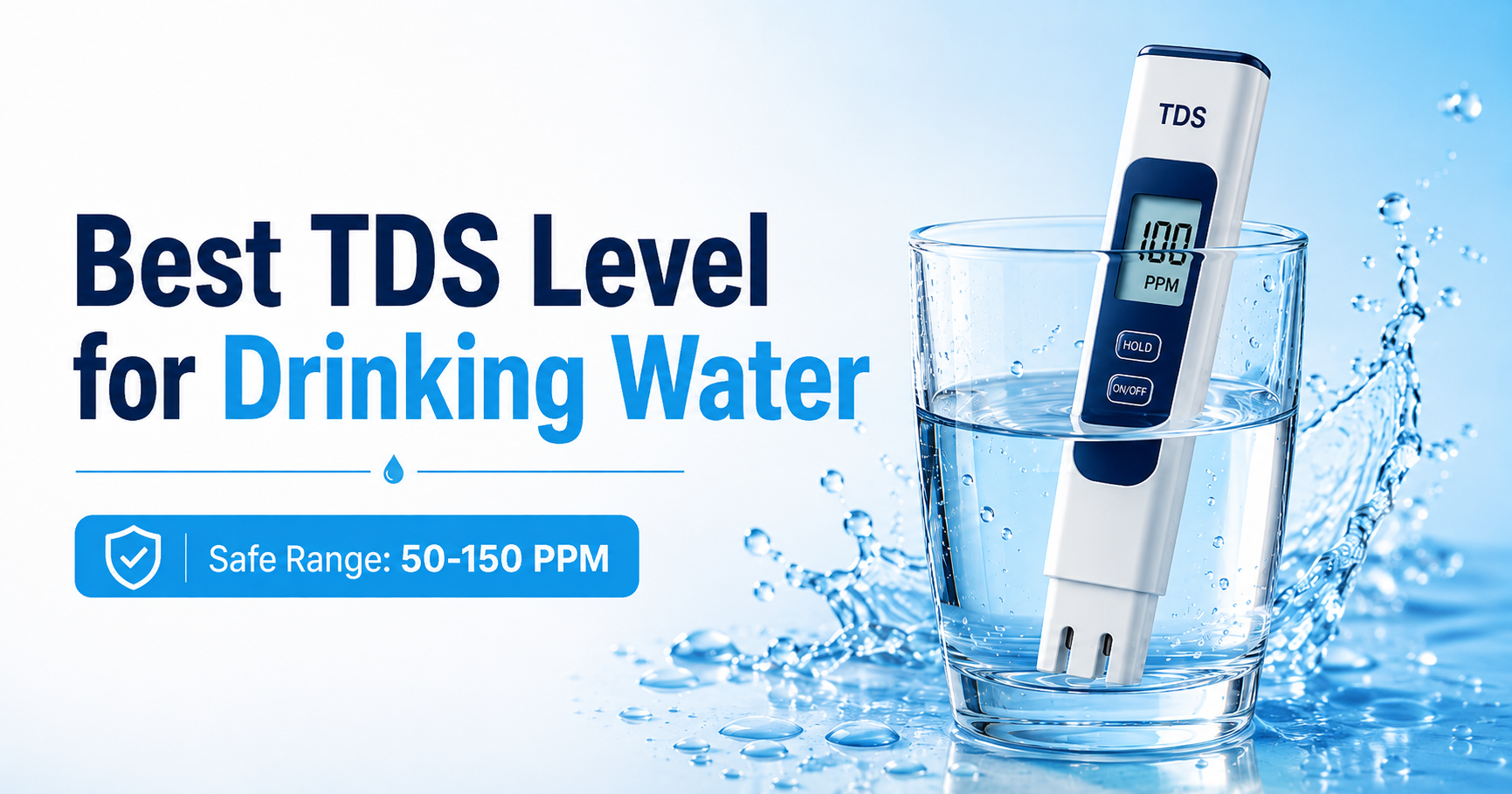
Ever wondered if your drinking water is actually safe? One of the simplest ways to know is by checking its TDS level. Yet most people have never heard of TDS, let alone know what number is safe. In this guide, we’ll explain exactly what the best TDS level for drinking water is, why it matters for your health, and how you can check it at home in seconds.
What Is TDS in Water?
TDS stands for Total Dissolved Solids. It measures the total amount of minerals, salts, and metals dissolved in your water, measured in parts per million (ppm) or milligrams per litre (mg/L).
These dissolved solids include both good minerals like calcium, magnesium, and potassium, and unwanted substances like lead, arsenic, chlorides, and nitrates. So TDS alone doesn’t tell you if water is “good” or “bad” — it tells you how much stuff is dissolved in it.
Water picks up these solids as it travels through soil, rocks, and pipes. That’s why borewell water, tap water, and packaged water can all have very different TDS readings.
What Is the Best TDS Level for Drinking Water?
According to widely accepted water quality standards, the ideal TDS level for drinking water is between 50 and 150 ppm. Water in this range tastes fresh, contains beneficial minerals, and is easy on your body.
| TDS Level (ppm) | Rating | What It Means |
|---|---|---|
| Less than 50 | Too low | Lacks minerals, flat taste |
| 50 – 150 | Excellent | Ideal for drinking |
| 150 – 300 | Good | Safe and acceptable |
| 300 – 500 | Fair | Upper limit of safe |
| 500 – 900 | Poor | Needs purification |
| Above 1200 | Unsafe | Do not drink |
The Bureau of Indian Standards (BIS) sets 500 ppm as the acceptable limit, with 2000 ppm as the maximum permissible only when no better source exists. For best taste and health, stay under 300 ppm.
Why TDS Level Matters for Your Health
When TDS is too high (above 500 ppm): Water may contain excess heavy metals, salts, or contaminants. Long-term use can cause kidney strain, digestive issues, and a salty taste. Common in borewell sources.
When TDS is too low (below 50 ppm): Water loses essential minerals. It tastes flat and may lead to mineral deficiencies. This is why purified water is often “re-mineralised.”
How to Check the TDS Level of Your Water
A digital TDS meter gives you a reading in seconds:
- Turn on the TDS meter and remove the cap
- Dip it into a glass of water up to the marked line
- Stir gently and wait for the reading to stabilise
- Note the number shown in ppm
- Compare it against the chart above
A good TDS meter is inexpensive and worth keeping at home, especially with an RO purifier.
What to Do If Your TDS Is Too High
If your water tests above 300–500 ppm, an RO water purifier is the most effective solution. Look for:
- RO + UV purification to remove dissolved solids and germs
- TDS controller or mineral balance to add back healthy minerals
- Live TDS display to see the purified output
Our RO water purifiers are designed for Indian water conditions, including high-TDS borewell sources, with mineral balancing.
How Often Should You Check Your Water’s TDS?
- Monthly if you’re on borewell or well water
- Every 3 months if on municipal tap water
- After every RO filter or membrane change
- Whenever the taste changes
A rising output TDS is the clearest sign your RO membrane needs replacing.
Frequently Asked Questions
What is the best TDS level for drinking water?
Between 50 and 150 ppm — fresh taste, healthy minerals, safe water. Up to 300 ppm is generally good.
Is 100 TDS water safe to drink?
Yes, 100 ppm is excellent — clean, well-mineralised, and great-tasting.
Is low TDS water bad for health?
Water below 50 ppm lacks minerals and tastes flat. Regular use may contribute to deficiencies.
What TDS level needs an RO purifier?
Above 300–500 ppm, an RO purifier is recommended to reduce TDS and remove heavy metals.
Can I drink water with 500 TDS?
500 ppm is the upper acceptable limit. Technically safe but often tastes salty; better purified with RO.
Final Thoughts
The best TDS level for drinking water is between 50 and 150 ppm — clean enough to be safe, mineralised enough to be healthy. If your water tests high, a good RO purifier brings it back to the ideal range. Explore our RO water purifiers and TDS meters to keep your family’s water safe.
Related guides
This article is part of our complete Water Quality Guide. Continue reading:
