





High TDS in Water: Health Effects & How to Reduce It

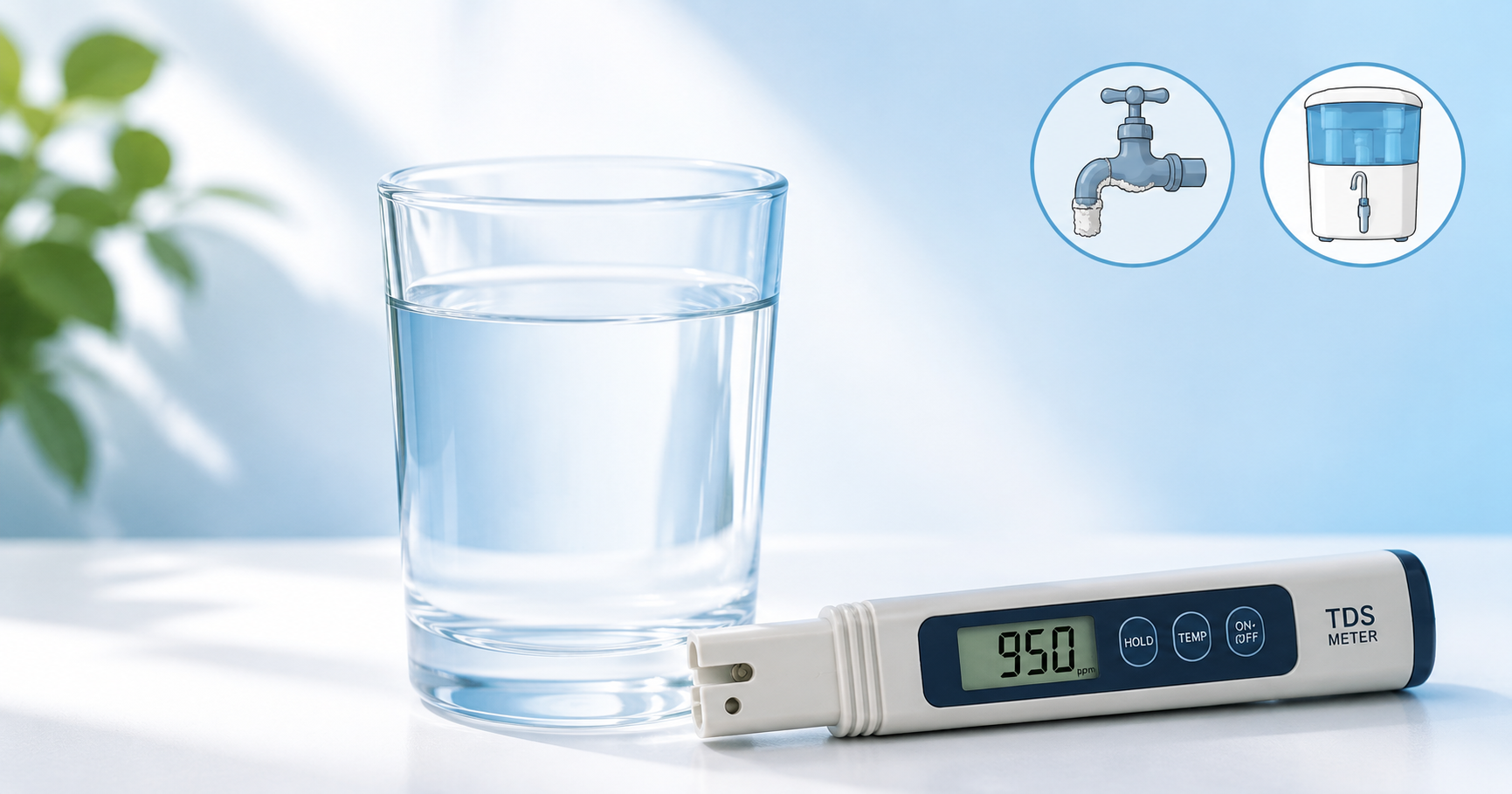
If your water tastes salty, bitter, or metallic, or leaves chalky white marks on utensils and taps, high TDS could be the reason. TDS (Total Dissolved Solids) measures everything dissolved in your water — minerals, salts, and metals combined. A little is normal and even healthy. Too much can affect the taste of your water, damage your appliances, and in some cases signal the presence of harmful contaminants.
This guide explains what counts as high TDS, the real health and household effects, and the practical ways to bring it down. If you first want to understand what a normal reading looks like, see our guide on the best TDS level for drinking water.
What Is Considered High TDS?
TDS is measured in parts per million (ppm) or milligrams per litre (mg/L). As a general reference used widely in India:
- Below 300 ppm — Considered good drinking water.
- 300 to 600 ppm — Acceptable for most households.
- 600 to 900 ppm — Noticeably hard; taste and scaling problems begin.
- 900 to 1200 ppm — High; not pleasant to drink, hard on appliances.
- Above 1200 ppm — Very high; generally considered unfit for regular drinking.
The Bureau of Indian Standards (BIS) sets an acceptable limit of 500 ppm for drinking water, with 2000 ppm as the permissible maximum only when no better source is available. So anything consistently above roughly 500 to 600 ppm is worth addressing.
One important caveat: TDS alone does not tell you what is dissolved in the water. A high reading could be harmless calcium and magnesium, or it could include harmful substances. This is why testing beyond a simple TDS meter matters — a point we cover in detail in our guide on testing water purity at home vs lab testing.
Health Effects of High TDS Water
The health impact of high TDS depends heavily on which dissolved solids are present. Elevated levels of harmless minerals are usually not dangerous, but high TDS often comes alongside issues worth knowing about.
Taste and Palatability
The most immediate effect is taste. High TDS water often tastes salty, bitter, or metallic. Many people simply drink less water when it tastes unpleasant, which can lead to lower daily water intake over time.
Digestive Discomfort
Water very high in certain salts, particularly sulfates and magnesium, can have a laxative effect and cause stomach upset for some people, especially those not used to it. Visitors and infants tend to be more sensitive.
Possible Harmful Contaminants
This is the real concern. A high TDS reading can mask the presence of dangerous substances such as lead, arsenic, nitrates, or fluoride in excess. These do not change the taste much but can pose serious long-term health risks. A TDS meter cannot distinguish safe minerals from these harmful contaminants — it only shows the total. If your area is known for groundwater contamination, a full laboratory test is the only reliable way to know what you are drinking.
Very Low TDS Is Not the Answer Either
It is worth noting that stripping water down to near-zero TDS is not ideal. Water in the range of roughly 80 to 150 ppm retains beneficial minerals like calcium and magnesium that your body needs. The goal is balanced water, not mineral-free water.
How High TDS Affects Your Home
Beyond drinking, high TDS quietly damages your household over time:
- Scale build-up: White, chalky deposits on taps, geysers, kettles, and utensils. This scaling clogs pipes and reduces water flow.
- Appliance damage: Water heaters, washing machines, and dishwashers wear out faster as scale coats their heating elements and reduces efficiency.
- Spots and stains: Dried water leaves visible white marks on glassware, tiles, and bathroom fittings.
- Skin and hair: Hard, high-TDS water can leave skin dry and hair rough after bathing.
- Reduced soap efficiency: Soap and detergent lather poorly, so you end up using more.
If scaling and appliance damage are your main concern rather than drinking water alone, a water softener may be the right solution alongside or instead of a purifier.
How to Reduce High TDS in Water
There are a few proven methods to lower TDS, each suited to different situations.
1. Reverse Osmosis (RO) — Most Effective
An RO water purifier is the most reliable way to reduce high TDS for drinking water. It forces water through a semi-permeable membrane that blocks dissolved salts, metals, and most contaminants, typically reducing TDS by 90% or more. A good RO system also removes lead, arsenic, and other harmful substances that a softener cannot. Modern RO purifiers add a mineral or TDS-control stage afterwards so the final water stays in the healthy 80 to 150 ppm range rather than being stripped completely.
2. Water Softeners — For Hardness and Scaling
A water softener uses ion exchange to swap the calcium and magnesium (which cause hardness and scaling) for sodium. This is excellent for protecting your whole home — geysers, washing machines, and plumbing — from scale. However, a softener does not make water safe to drink on its own; it does not remove harmful contaminants. Softeners are best for bathing, washing, and appliance protection, usually paired with an RO unit for drinking water.
3. Distillation — Effective but Slow
Distillation boils water into steam and condenses it back, leaving dissolved solids behind. It is very effective at reducing TDS but is slow, energy-intensive, and impractical for daily household volumes. It also removes all minerals, so the water is flat and mineral-free.
What Does Not Work
Simple boiling does not reduce TDS — it kills germs but leaves dissolved solids behind, and can even concentrate them slightly as water evaporates. Ordinary carbon or UF filters improve taste and remove some impurities but do not significantly lower TDS. For genuinely high TDS, RO is the practical answer.
Which Solution Is Right for You?
- High TDS drinking water, want it safe and tasty: RO water purifier.
- Scaling on taps and appliances, hard water for bathing: Water softener.
- Both problems (very common in hard-water areas): RO for the kitchen tap plus a softener for the home supply.
Before buying anything, check your actual TDS with a meter, and if your area has known contamination, get a lab test. Knowing your real numbers helps you choose the right system instead of over-treating or under-treating your water.
Key Takeaways
- High TDS generally means readings consistently above 500 to 600 ppm; above 1200 ppm is usually unfit for drinking.
- The main effects are unpleasant taste, digestive discomfort for some, scaling that damages appliances, and the possibility of hidden harmful contaminants.
- A TDS meter shows the total but not what is dissolved — lab testing is essential where contamination is a risk.
- RO is the most effective way to reduce high TDS for safe drinking water; a softener handles hardness and scaling for the whole home.
- Aim for balanced water around 80 to 150 ppm, not mineral-free water.
Understanding your water is the first step to fixing it. Test your TDS, learn what a safe TDS level looks like, and if in doubt about contaminants, follow up with proper home and lab testing before choosing your solution.
Related guides
This article is part of our complete Water Quality Guide. Continue reading:
