





How to Test Water Purity at Home vs Lab Testing: A Practical Guide for Indian Households

Most Indian households judge their water by taste, colour and the number on a TDS meter. That is a fair start, but the contaminants that cause real harm – arsenic, fluoride, nitrate, lead and disease-causing bacteria – are colourless, odourless and invisible to a TDS reading. This guide explains how to test water purity at home, what each test can and cannot tell you, what only an accredited laboratory can measure, and how to build a testing routine for municipal, tanker and borewell water in India.
What “pure water” actually means
Drinking water is judged on three fronts, and the Bureau of Indian Standards specification IS 10500:2012 sets limits for each:
- Physical: turbidity (cloudiness), colour, odour and taste; acceptable turbidity is 1 NTU, 5 NTU permissible.
- Chemical: pH (6.5–8.5), TDS (500 mg/L acceptable, 2,000 permissible where no better source exists), hardness (200 acceptable, 600 permissible), fluoride (1.0 acceptable, 1.5 permissible), nitrate (45 mg/L), arsenic and lead (0.01 mg/L each), plus iron, chloride, sulphate and pesticides.
- Biological: total coliforms and E. coli must be absent in every 100 mL sample, with no relaxation.
“Pure” therefore means “within limits on all three fronts”, not simply “low TDS”. Home tests cover part of the physical and chemical picture; the biological and trace-chemical picture is laboratory territory.
How to test water purity at home: the common tests
1. TDS meter
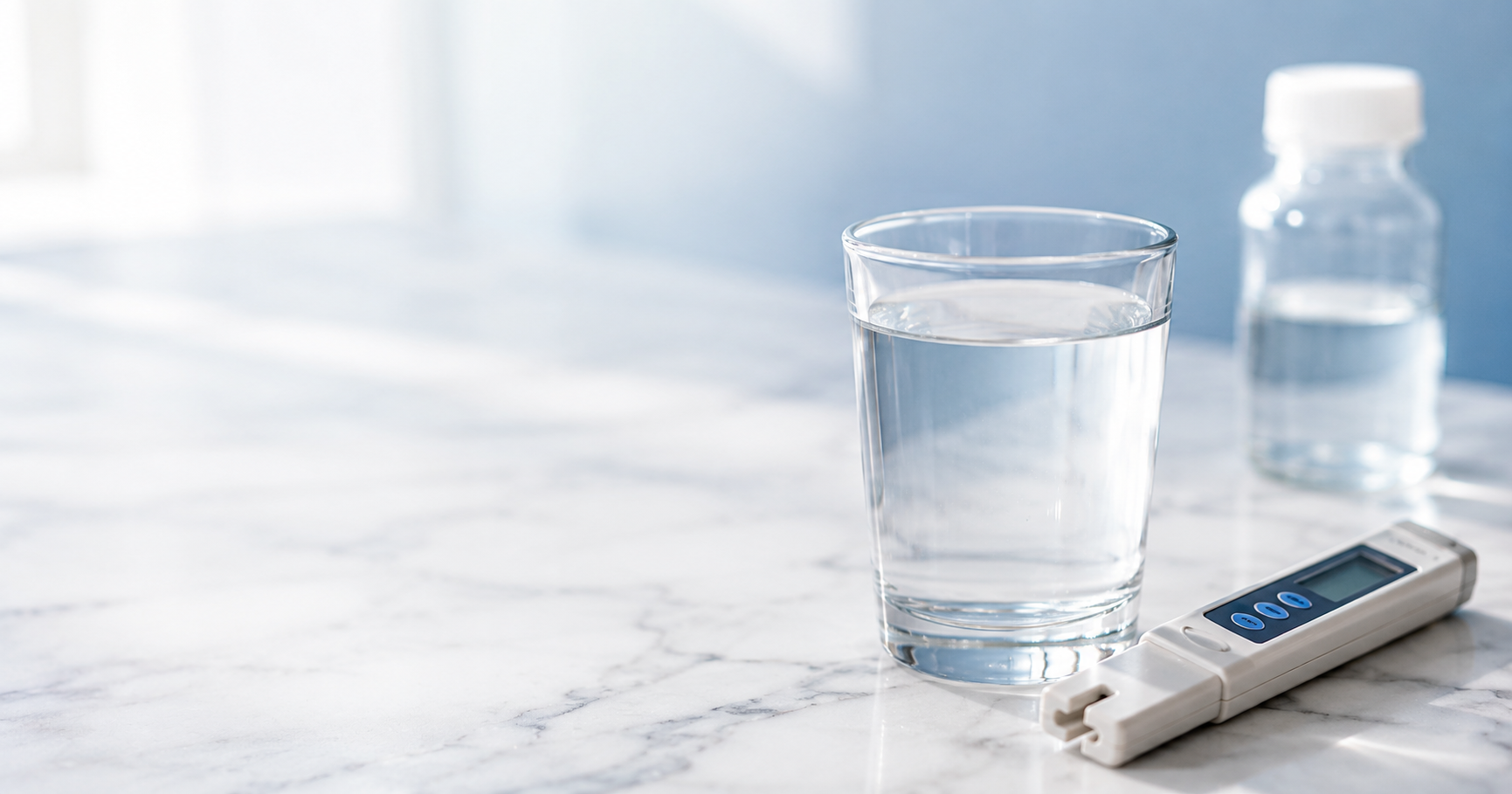
A pen-style TDS meter (₹200–600) measures electrical conductivity and converts it into an estimate of dissolved solids in ppm (mg/L). Dip it in a glass of water for 10–20 seconds and read the number.
What it tells you: the total mineral and salt load; whether an RO membrane is still working (compare output with input); and sudden source changes. Compare the reading against the safe TDS range for drinking water.
What it does NOT tell you: what those solids are. Calcium and magnesium raise TDS in exactly the same way that lead, arsenic and nitrate do, and the meter cannot tell them apart. Two glasses can both read 500 ppm: one is hard but harmless well water rich in calcium, the other carries arsenic at twenty times the BIS limit. On the meter’s screen they look identical. A TDS meter also says nothing about bacteria, viruses, pesticides or fluoride.
2. pH strips or a pH pen
pH strips (₹100–300) or a pocket pH pen (₹400–1,000) show whether water is acidic or alkaline. The BIS range is 6.5–8.5.
What it tells you: whether water is corrosive (low pH leaches metals from old pipes and brass fittings) or scale-forming (high pH).
What it does NOT tell you: a pH within range is not a safety certificate – arsenic-affected groundwater is usually neutral. Strips resolve to about ±0.5 units, and pens drift unless calibrated.
3. Hardness: test strips or the soap test
Hardness is calcium plus magnesium, expressed as CaCO3. Hardness strips (₹300–800) give a colour-scale reading. The zero-cost alternative is the soap test: fill a clear bottle one-third with water, add a few drops of pure liquid soap (not detergent), cap and shake hard for ten seconds. Soft water gives a thick lather over clear water; hard water gives little lather and turns milky with a scummy film.
What it tells you: why your geyser scales and soap will not lather, and whether a softener is worthwhile.
What it does NOT tell you: anything about safety. Hardness within permissible limits is not a health hazard; hard water can be perfectly safe while soft water is contaminated.
4. Chlorine test strips
Municipal supply is chlorinated. Free-chlorine strips (OTO or DPD type, ₹200–500) show the residual remaining. BIS expects at least 0.2 mg/L at the consumer end, up to 1 mg/L where viral protection is needed.
What it tells you: whether treated supply still carries a protective residual at your tap. Zero residual in a piped municipal supply is a warning sign of contamination risk in the line or your storage tank.
What it does NOT tell you: chlorine present does not prove microbes absent. Organisms such as Cryptosporidium are chlorine-resistant, and a residual can be used up by contamination downstream of the test point. Irrelevant for unchlorinated borewell water.
5. Visual and smell observation
Fill a clear glass, let it stand 30 minutes against white paper, then look and smell:
- Cloudy or hazy water: suspended particles, possible sewage or surface-water ingress.
- Reddish-brown water or rust stains: iron, common in Assam, the North-East, parts of Odisha and West Bengal.
- Rotten-egg smell: hydrogen sulphide from bacteria in borewells or stagnant tanks.
- Earthy or musty smell: algae or organic growth in overhead tanks.
- White crust on vessels: hardness.
What it tells you: gross problems and the state of your storage tank. What it does NOT tell you: fluoride, arsenic, nitrate, lead and coliform bacteria are colourless, odourless and tasteless at harmful levels. Clear water is not evidence of clean water.
6. Multi-parameter strip kits
“14-in-1” or “16-in-1” strip kits (₹500–1,500) cover pH, hardness, chlorine, nitrate/nitrite, iron, copper and alkalinity; some add fluoride or lead pads and a hydrogen-sulphide (H2S) vial for bacteria.
What it tells you: a broad screen that flags what deserves lab follow-up.
What it does NOT tell you: readings are semi-quantitative colour matches; heavy-metal pads have detection limits near or above the BIS limits and give false negatives; the H2S vial screens for sulphide-producing bacteria, not the coliform count the standard requires. Treat any positive as “go to a lab” and any negative as “not proven”.
What only a laboratory can do
- Bacteriology. Total coliforms and E. coli per 100 mL by MPN or membrane filtration, incubated 24–48 hours – the single most important test for households with infants, elderly or immunocompromised members.
- Heavy metals at ppb level. Arsenic, lead, cadmium, chromium and mercury by atomic absorption or ICP-MS. The BIS limit for arsenic and lead is 0.01 mg/L – 10 parts per billion, far below what any strip can quantify. Arsenic in shallow tubewells across the Ganga–Brahmaputra plains of West Bengal, Bihar, Assam and eastern Uttar Pradesh is a well-documented problem.
- Fluoride and nitrate panel. High-fluoride groundwater is widespread in Rajasthan, Gujarat, Andhra Pradesh, Telangana and Karnataka (the fluorosis belt); nitrate is elevated in intensively farmed districts and matters most for infants.
- Pesticides, iron and manganese, alkalinity and the full IS 10500 panel of 30–45 parameters.
- An officially usable report. For a builder or RWA dispute, tenancy or institutional compliance, only a report from a lab accredited by NABL (National Accreditation Board for Testing and Calibration Laboratories, ISO/IEC 17025) carries weight.
Home testing vs lab testing: side by side
| Aspect | Home tests | NABL / government lab |
|---|---|---|
| Cost | ₹200–1,500 one-time; kits are reusable | Nominal fee to ~₹2,000 (basic panel, JJM / PHED labs); ₹3,000–8,000+ (full IS 10500 panel, private NABL labs) |
| Time to result | Seconds to minutes | 3–10 working days (bacteriology alone needs 24–48 h) |
| Parameters | 1–16, semi-quantitative | 30–45+, quantitative against BIS limits |
| Bacteria (coliform / E. coli) | No (H2S vial screening at best) | Yes, per 100 mL |
| Heavy metals at ppb (As, Pb, Cd, Hg) | No | Yes (AAS / ICP-MS) |
| Fluoride / nitrate | Rough colour match | Accurate to the decimal |
| Legally / officially usable | No | Yes, if NABL-accredited |
| Best used for | Monthly monitoring, RO checks, spotting change | Baseline, annual verification, health concerns |
Where to get water tested in India
- Jal Jeevan Mission laboratories. More than 2,000 district and sub-divisional labs run by state PHED departments are open to the public at a nominal fee, and many are NABL-accredited. Find the nearest through the JJM Water Quality Management Information System (WQMIS) on the ejalshakti portal or your district PHED office. At village level, JJM-trained women run field test kits – ask the Gram Panchayat.
- Municipal water board and State Pollution Control Board labs in most cities accept residents’ samples for a fee.
- Private NABL-accredited labs. Search the NABL directory (nabl-india.org) and confirm the certificate scope lists the parameters you need – accreditation is parameter-specific.
How to collect a sample correctly
A good lab cannot rescue a bad sample. Follow these steps:
- Collect bottles from the lab: a sterile bottle for bacteriology (usually pre-dosed with sodium thiosulphate to neutralise chlorine), a clean 1–2 litre bottle for the chemical panel, and an acid-preserved bottle if metals are tested. Never reuse an old packaged-water bottle for bacteriology.
- Sample the tap you actually drink from. To diagnose the source, also sample at the borewell outlet, tanker or before the overhead tank; to judge a purifier, submit raw and purified water separately.
- Remove the tap aerator, wipe the tap mouth and let water run 2–3 minutes; for a borewell, run the pump 5–10 minutes until flow is steady.
- For bacteriology, do not touch the inside of the bottle or cap, fill to the shoulder leaving an air gap and close immediately. Rinse the chemical bottle two or three times with sample water, then fill to the top.
- Label with source, location, date, time and whether the water is chlorinated.
- Keep samples cool and dark in an ice box. Bacteriology samples should reach the lab within 6 hours, never later than 24 hours refrigerated; chemical samples within 24–48 hours.
- Avoid sampling right after tank cleaning, pipe repairs or heavy rain, unless that disturbance is what you want to check.
A practical testing routine
- Monthly at home: TDS on raw and purified water, hardness and pH, a chlorine strip if on municipal supply, and a visual check.
- Once a year at a lab for municipal or tanker supply: at minimum bacteriology, arsenic, fluoride, nitrate and lead; ideally the full IS 10500 panel.
- Twice a year for borewell water: pre-monsoon (April–May, when the water table is lowest and concentrations peak) and post-monsoon (October–November, when recharge and runoff carry fresh contamination).
- Test immediately if any of these happen: a sudden change in taste, colour or smell; a TDS reading well above its usual value; stomach illness at home, especially after rains; a new or deepened borewell; flooding or sewer overflow nearby; new construction or industry nearby; a pipeline repair; a pregnancy or newborn at home; moving house; or purified-water TDS creeping upward.
Summary
Home tests are cheap, fast and excellent for spotting trends: they tell you when something has changed. They cannot tell you whether water contains bacteria, arsenic, lead, fluoride or nitrate, and a TDS meter cannot distinguish a harmless mineral from a toxic one. Combine both: monthly home checks, an annual NABL laboratory panel (twice a year for borewells), and awareness of the contaminants your region is known for.
Water quality varies by location, source and season, and can change without any visible sign. If you have a health concern or rely on groundwater, get a NABL-accredited laboratory analysis of your own supply and consult a qualified professional before drawing conclusions.
Related guides
This article is part of our complete Water Quality Guide. Continue reading:
