





Water Purifier Buying Guide: RO vs UV vs UF Explained (2026)

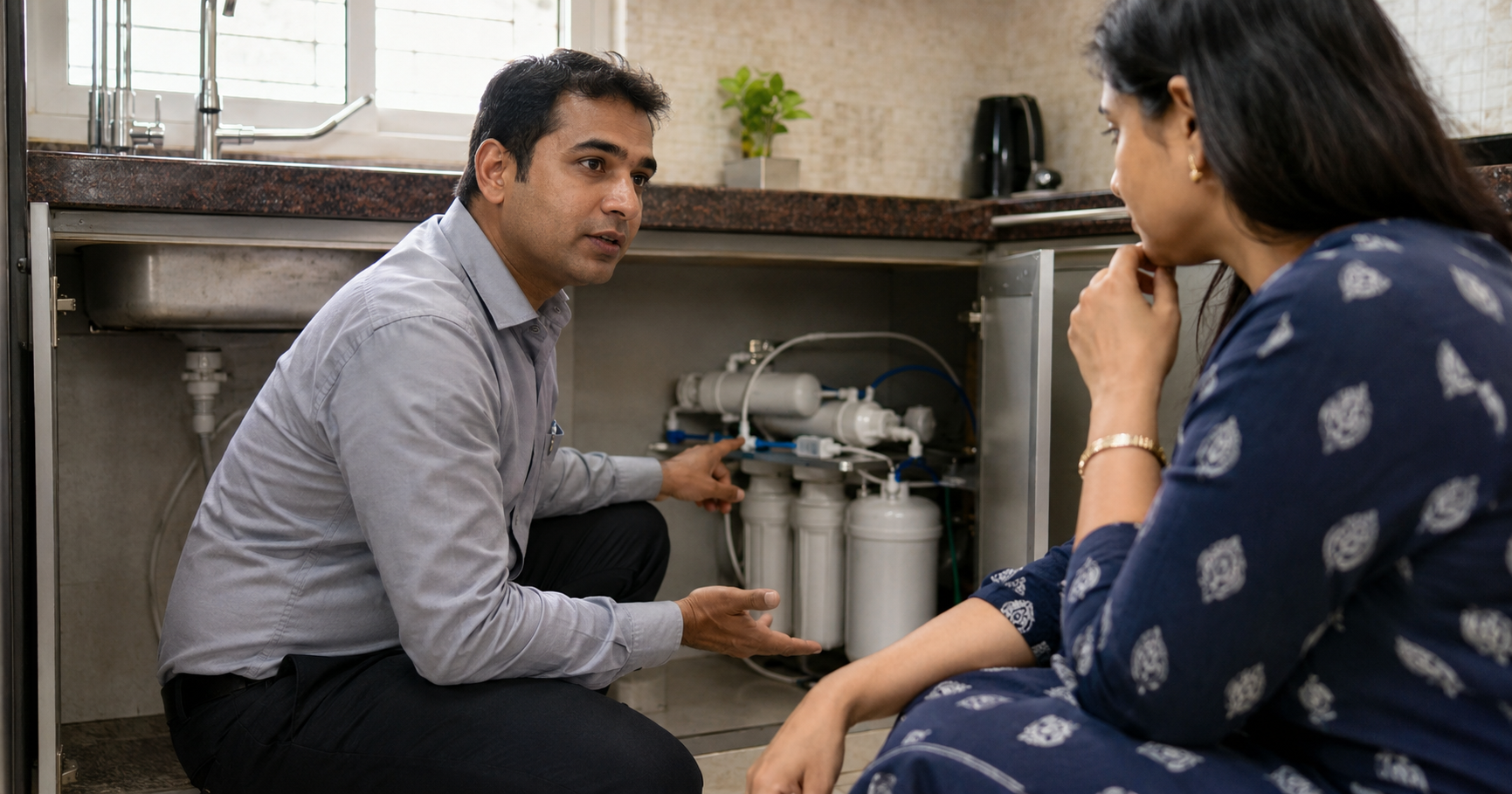
Buying a water purifier in India can be confusing. RO, UV, UF, RO+UV, copper, alkaline — the jargon is endless, and the wrong choice means either paying for filtration you don’t need or, worse, not removing what’s actually in your water. This guide cuts through the confusion and explains RO, UV, and UF in plain language, so you can choose the right purifier for your home in 2026.
First: it depends on your water
There is no single “best” purifier — the right one depends entirely on what’s in your water. That’s why the first step, before buying anything, is knowing your water’s quality, especially its TDS (total dissolved solids) and whether it has bacterial or other contamination. A quick test tells you what you actually need. See our guide on testing your water. With that in hand, here’s what each technology does.
RO (Reverse Osmosis)
What it does: RO forces water through a very fine membrane that removes dissolved solids, salts, heavy metals, and many contaminants. It’s the only common technology that reduces high TDS.
- Best for: high-TDS water — borewell water, hard water, water that tastes salty or bitter.
- Removes: dissolved salts, heavy metals (like arsenic, lead), high TDS, and most impurities.
- Keep in mind: RO wastes some water during purification and removes some good minerals too (many units add them back). See our guide on RO water wastage.
If your water is high-TDS or from a borewell, you almost certainly need RO.
UV (Ultraviolet)
What it does: UV uses ultraviolet light to kill bacteria, viruses, and other microorganisms in the water. It disinfects, but does not remove dissolved solids or change the taste.
- Best for: water that is low in TDS but may have microbial contamination — like municipal water that’s soft but not guaranteed germ-free.
- Removes: bacteria, viruses, and germs (kills them).
- Keep in mind: UV does nothing for high TDS, salts, or heavy metals — it only handles living organisms.
If your water is low-TDS but you’re worried about germs, UV is what you need.
UF (Ultrafiltration)
What it does: UF uses a membrane with slightly larger pores than RO to remove suspended particles, bacteria, and cysts — without electricity and without removing dissolved solids.
- Best for: low-TDS water with visible impurities or turbidity; areas with irregular power, since UF works without electricity.
- Removes: mud, dirt, suspended particles, bacteria, and cysts.
- Keep in mind: UF does not remove dissolved salts or reduce TDS, and doesn’t kill viruses as reliably as UV.
The simple decision guide
- High TDS / borewell / hard / salty water → you need RO (often RO+UV for complete protection).
- Low TDS but possible germs (municipal water) → UV or UF is enough; RO isn’t necessary.
- Low TDS with mud/particles, or no reliable electricity → UF.
- Not sure / mixed supply → RO+UV covers the widest range of problems.
The golden rule: use RO only if you have high TDS. Using RO on already-low-TDS water strips out good minerals unnecessarily. Using only UV or UF on high-TDS water leaves the dissolved salts untreated. Matching the technology to your water is everything.
What about copper, alkaline, and mineral purifiers?
These are add-on features layered on top of RO/UV/UF, not separate core technologies. Copper and alkaline options can add taste or claimed wellness benefits, and mineral cartridges add back healthy minerals RO removes. They’re nice-to-haves — decide your core technology (RO/UV/UF) first based on your water, then consider these extras if you want them.
Don’t forget hardness is separate
One important point: purifiers make your drinking water safe, but they don’t protect your whole house from hard-water scale. If your water is hard, a purifier at the kitchen tap won’t stop your geysers and appliances scaling up — that needs a water softener. Many Indian homes use both. See softened water vs RO water to understand the difference.
In summary
Choosing a purifier comes down to your water: RO for high TDS, UV to kill germs in low-TDS water, UF for particles and no-electricity situations, and RO+UV when you need broad protection. Always test your water first, match the technology to what’s actually in it, and remember that hardness needs a softener, not a purifier. For expert guidance and a full range of purifiers suited to Indian water, explore DraQua.
