





Soot, Oil and Crackers: What Diwali Leaves in Your Terrace Water Tank

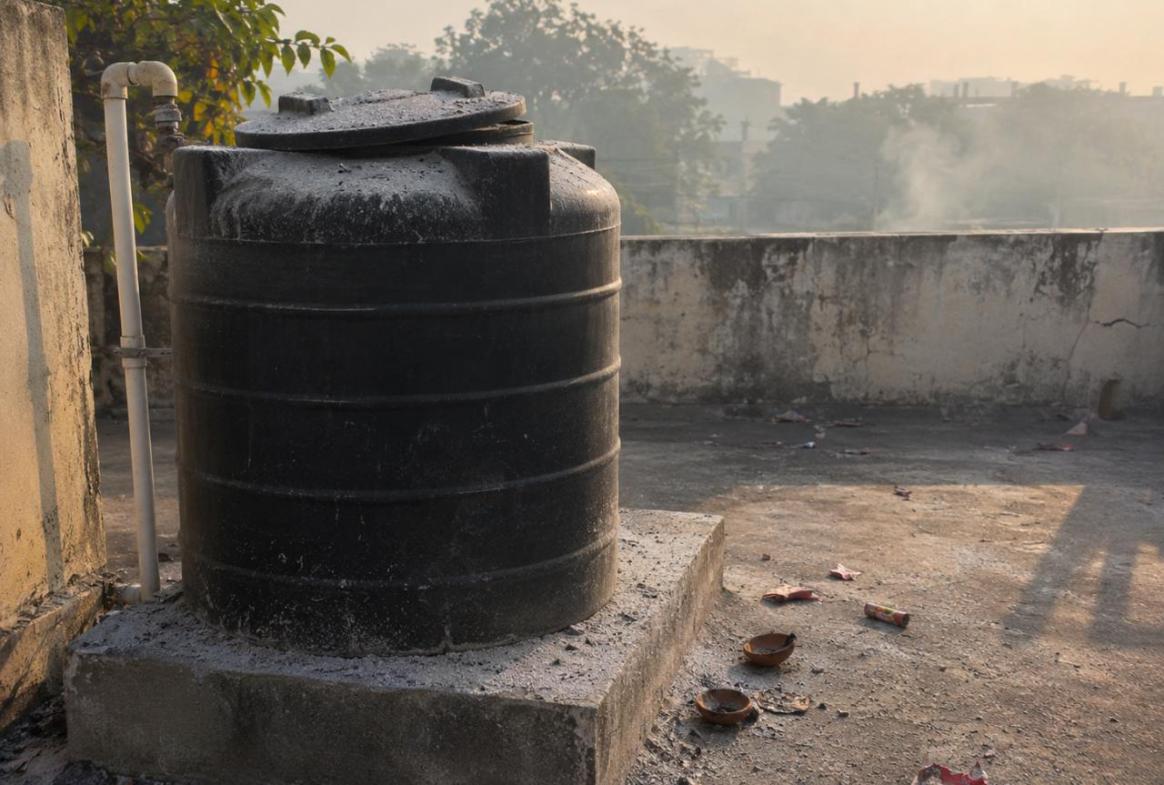
For three or four days every Diwali, the air above your house carries far more than usual — lamp soot, cracker smoke, burnt paper and fine ash. Most of it comes down again within a day or two. And in most Indian homes, the flattest, most exposed surface it lands on is the terrace: the same terrace that holds your overhead water tank.
This is not a scare story. The amount that gets into a closed tank is small. But it is not zero, and it explains something many families notice in the week after the festival — water that looks slightly cloudy, a faint smoky or stale smell, and a purifier that seems to be working harder than it did last month.
What actually lands on your terrace
Three separate things settle during the festival week:
- Lamp and candle soot. Oil and wax burn imperfectly. The black film you wipe off a diya plate is carbon, and the same film lands on every nearby flat surface, including the tank lid.
- Cracker residue. Fireworks use metal salts to make colour — copper for blue-green, strontium for red, barium for green, aluminium and magnesium for the white sparks. After burning, these come down as very fine dust along with unburnt paper and clay fragments.
- General particulate load. Air quality in most Indian cities worsens sharply for a few days around Diwali. More dust in the air simply means more dust settling everywhere.
On a terrace this collects quietly. You do not see it until the first rain or the first wash, when it moves.
Why the overhead tank is the weak point
A terrace tank is not sealed the way people assume. Look at yours and you will usually find three openings:
- A lid that rests on top rather than locking down. Many have a chipped rim or a missing clamp.
- An air vent, which has to exist — a tank that cannot breathe will collapse inward as it empties.
- An overflow pipe, often with no mesh on the outer end.
Each of these is a small path inward. Settled dust does not need much help: a gust of wind, someone walking past, or water splashing during a terrace wash is enough to carry a share of it through a gap and into the tank.
If you have ever wondered why rooftop-collected water is not automatically clean, the same reasoning applies there. We covered that in detail in terrace rainwater vs borewell water.
What it does to your water
Honestly, the health risk from the quantity involved is low. The practical effects are the ones you will actually meet:
| What gets in | What you notice |
|---|---|
| Carbon soot, fine ash | Faint grey tint; water looks “not quite clear” in a glass |
| Burnt paper, clay bits | Visible specks; sediment at the bottom of a stored pot |
| Organic matter, dust | Stale or smoky smell, strongest in the first tap of the morning |
| Metal salts from crackers | No taste or smell at these levels; removed by RO if present |
| Higher turbidity overall | Pre-filter clogs faster; purifier output slows |
That morning smell has more than one possible cause — stagnation overnight is the usual one. If that is your main complaint, read why your water smells only in the morning before blaming the festival.
What it does to your purifier
This is where most people feel it, usually two to four weeks later rather than immediately.
Your sediment pre-filter is the part that catches suspended matter. Push more suspended matter through it and it loads up sooner. A pre-filter that would normally run six months may be visibly brown in three. Once it is choked, pressure to the RO membrane drops, output per hour falls, and the pump runs longer for the same amount of water — which is also one of the reasons a purifier starts sounding louder than it used to.
Worth being clear about the division of labour here: the sediment filter handles particles, the RO membrane handles dissolved substances. They are not interchangeable, which is the point of filter versus purifier.
What to do this week
None of this needs a professional unless your tank has not been opened in years.
- Sweep the terrace before you wash it. This is the step people skip. Hosing a dusty terrace pushes residue toward the tank base and the drain together. Sweep dry first, collect, then wash.
- Wipe the tank lid and the area around it before you open the lid — not after. Anything sitting on the lid falls straight in otherwise.
- Look inside. A torch is enough. You are looking for a film on the water surface, or a dark layer on the floor of the tank.
- If there is sediment, drain and clean. Empty it, scrub the walls and floor with a brush and plain water, rinse twice, refill. Avoid strong detergents — the residue is harder to rinse out than the dirt was.
- Check the three openings. Fit a proper lid if yours does not seat flat. Tie a piece of fine mesh over the overflow pipe end and the vent. This is a ten-rupee job that stops most of next year’s problem.
- Change the sediment pre-filter. If it is more than halfway through its normal life, replace it now rather than waiting for the output to drop.
Do the tank first and the filter second. Changing the filter while the tank is still dirty just spends a new filter on old sediment.
Should you test the water?
If the water clears up within a few days of cleaning the tank, no. If a smell, a taste or a tint persists after a proper clean, then yes — the festival is probably not the cause and something else is going on. A home TDS meter will not show you soot or turbidity, so this is a case for a lab test rather than a strip. Home testing versus lab testing explains which one answers which question, and how to read the report when it comes back.
Bottom line
Diwali does not poison your water tank. What it does is add a few weeks’ worth of dust in a few days, and that load lands first on your tank and then on your pre-filter. Sweep before washing, wipe the lid before opening it, mesh the vent and overflow, and change the pre-filter. Half an hour on the terrace this week saves a service call in December.
If your pre-filter is due, the IVES RO Service Kit (Spun + Carbon + Post) at ₹380 covers all three replaceable stages in one go.
