Water Filter vs Water Purifier: They Are Not the Same Thing


Every shop, every advert and every neighbour uses “filter” and “purifier” as if they were one word. They are not. The difference decides whether your water is actually safe or just clearer than it was. Here is the short version. A filter removes things. A purifier removes or kills things a filter cannot. The rest of this post explains those two sentences, and where each one belongs in a home.
What a filter actually does
A filter is a strainer. Water passes through a material with openings, and anything bigger than those openings is held back. That is the whole mechanism. Sand, silt, rust flakes from old pipes and any visible particle are stopped at the filter and never reach the glass.
Add an activated carbon stage and the filter can do a little more. Carbon holds on to chlorine, its smell and some organic compounds, which is why water from a carbon filter tastes noticeably better. A filter makes water clearer and better tasting. That is a real job, and it is the first job. It is just not the only job.
What a filter cannot do
A filter cannot remove anything that is dissolved. Dissolved salts, the calcium and magnesium that make water hard, fluoride, nitrate, arsenic and most heavy metals are not floating in the water as particles. They are part of the water itself, the way sugar is part of stirred tea. There is nothing to strain, so a strainer cannot help. This is why water from a plain filter can look perfectly clear and still carry a high TDS reading. Our post on common water impurities lists the rest.
Then there are living organisms. A sediment or carbon filter is not designed to hold back bacteria and viruses, and it does not reliably do so.
What a purifier does that a filter does not
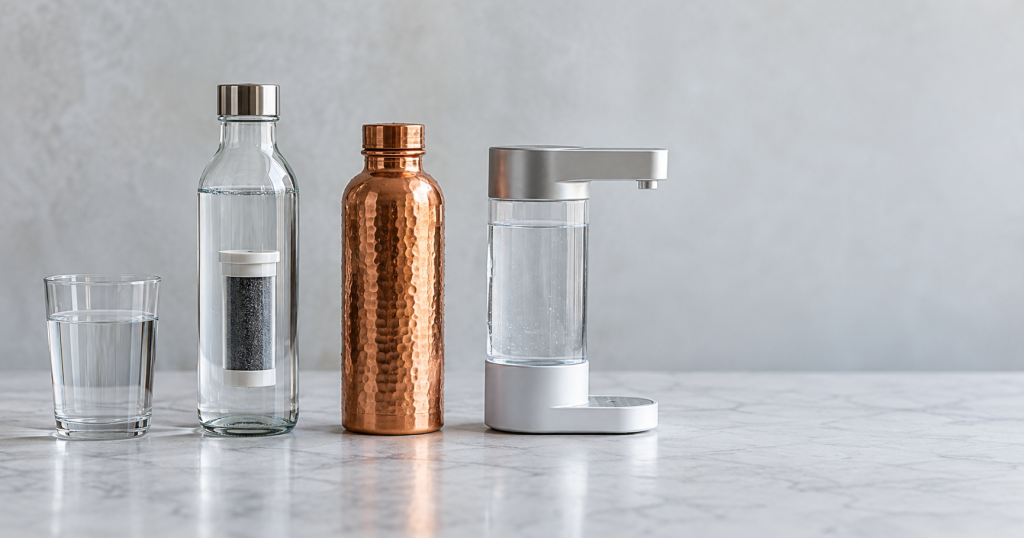
A purifier is built for the invisible load: the dissolved contaminants and the living organisms a filter lets through. Three technologies do that work.
- RO (reverse osmosis) pushes water under pressure through a membrane so fine that dissolved ions cannot pass. Salts, hardness, fluoride and heavy metals stay behind and go out with the reject water. It is the only one of the three that lowers TDS.
- UV (ultraviolet) passes the water past a lamp. The light damages bacteria and viruses so they cannot multiply. UV removes nothing at all; what comes out has the same dissolved content as what went in.
- UF (ultrafiltration) is a fine membrane that holds back bacteria and cysts by size. It needs no electricity and leaves dissolved minerals untouched, so it does nothing for TDS either.
The point everyone misses: a purifier contains filters
Open almost any RO unit and the first stages are a sediment filter and a carbon filter, sitting in front of the membrane. They are not there to purify. They are there to protect the membrane, which silt would clog and chlorine would damage if raw water reached it. The purifying happens at the membrane, and at the UV lamp further along.
So the question was never filter versus purifier. The filter is a stage inside the purifier. Every purifier has filters; not every filter is a purifier. Once you see that, the shop’s loose use of the two words stops being confusing and starts being a warning sign.
What each one handles
Side by side, the difference is obvious.
| Problem | Plain filter | Carbon filter | RO | UV or UF |
|---|---|---|---|---|
| Sand, silt and rust | Yes | Yes | Yes | UV no, UF yes |
| Chlorine and odour | No | Yes | Yes, carbon stage | No |
| Dissolved salts and TDS | No | No | Yes | No |
| Hardness | No | No | Yes, drinking water only | No |
| Fluoride, nitrate, arsenic | No | No | Yes | No |
| Bacteria and viruses | No | No | Mostly; usually paired with UV | UV yes; UF bacteria and cysts only |
| Taste and clarity | Clarity only | Both | Both | UV neither, UF clarity only |
Where a plain filter is genuinely the right answer
A filter is often enough. Four places where it is exactly the right tool:
- At the inlet, before the overhead tank or the purifier, to catch sediment first.
- On the washing machine or geyser line, where particles wear out valves and nothing needs to be drinkable.
- On a shower, where the issue is chlorine on skin and hair.
- In a home on clean municipal supply with low TDS, where the only complaint is a few particles or a chlorine smell.
In that last case an RO unit is money spent on a problem you do not have, and minerals stripped for nothing. Our post on RO myths covers that one.
Where you need a purifier
Borewell or tanker water, a high TDS reading, any chance of fluoride, nitrate or heavy metals, or any risk of bacterial contamination: these are purifier problems, and no filter will touch them. Borewell water in particular tends to carry several of them at once.
What decides it is the test report, not the shop. A shop sells what it stocks. A water test report tells you what is actually in your water, and that is what the decision should rest on.
The words on the box
Marketing does not respect the distinction. “Filter”, “purifier” and “water filtration system” get used loosely, sometimes on the same carton. So ignore the word on the box and read the list of stages inside it. A unit that lists only sediment and carbon stages is a filter, whatever the box calls itself. A unit that lists RO, UV or UF is doing more.
And boiling fits in neither box
Boiling kills germs, so it does part of a purifier’s job and none of a filter’s; the silt and the dissolved salts are all still there afterwards. Our post on boiling versus RO goes through exactly what boiling does and does not remove.
Bottom line
A filter makes water look and taste better. A purifier makes water safe when the problem is one you cannot see. Many homes need both, in sequence: a filter at the inlet for sediment, and a purifier at the kitchen tap for the rest. Test first, then decide which one your water actually needs. For which technology to buy, our RO vs UV vs UF buying guide walks through that choice. If your test points to a purifier, the AVINYA ZENITH Edge is one we stock, with sediment and carbon stages in front of RO, UV and UF.