Why Your Neighbour’s Water Is Fine and Yours Isn’t


Your neighbour’s tap water is clear and tastes fine. Yours smells, stains the sink or leaves white marks on the tap. Same street, same rain, same municipal line. It feels unfair, and it feels like something is wrong with your house. Usually something is. And it can be found, usually in one evening.
Reason 1 — different borewells, different layers
Two borewells thirty feet apart can hit completely different rock and water layers. A deeper borewell often draws more mineralised, harder water. A shallower one may be softer but more exposed to surface contamination. Even two borewells of the same depth can differ, because the rock fractures feeding them are not the same. Depth and location decide the water, not the street. Our guide to borewell water problems explains what each layer tends to bring up.
Reason 2 — one house is on borewell, the other on supply
Many Indian streets are mixed. One house has a municipal connection, the next runs on its own borewell, and a third has both. A neighbour on supply and you on borewell means two completely different waters, even though the houses touch. Also common: the neighbour blends supply and borewell in the sump and you do not. Ask what they are actually drinking before you compare.
Reason 3 — tankers
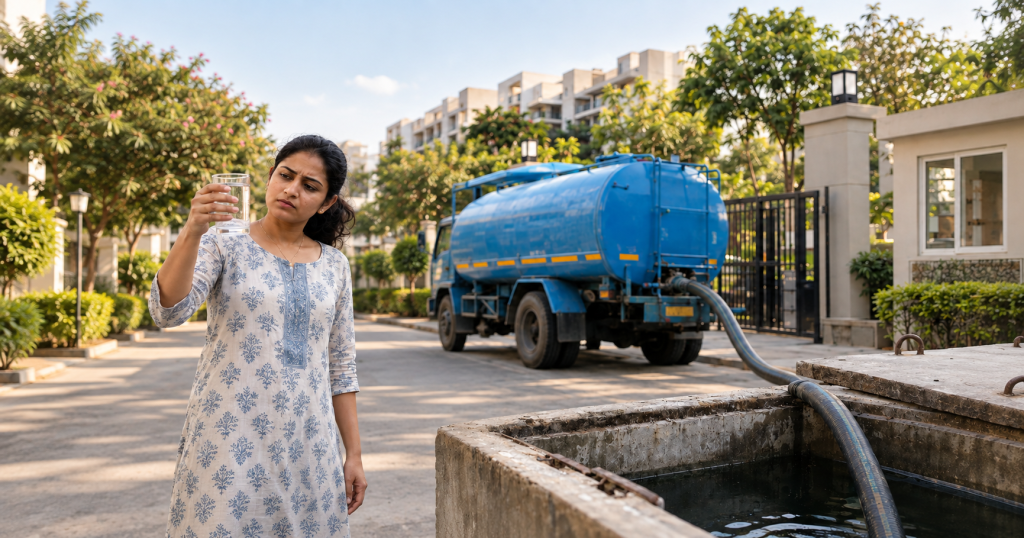
If either house takes tanker water, the source can change from one week to the next. Comparing your tap with a neighbour’s on a single day tells you very little. Our step-by-step guide to tanker water explains what to ask the supplier and what to check when the truck arrives.
Reason 4 — your plumbing, not your water
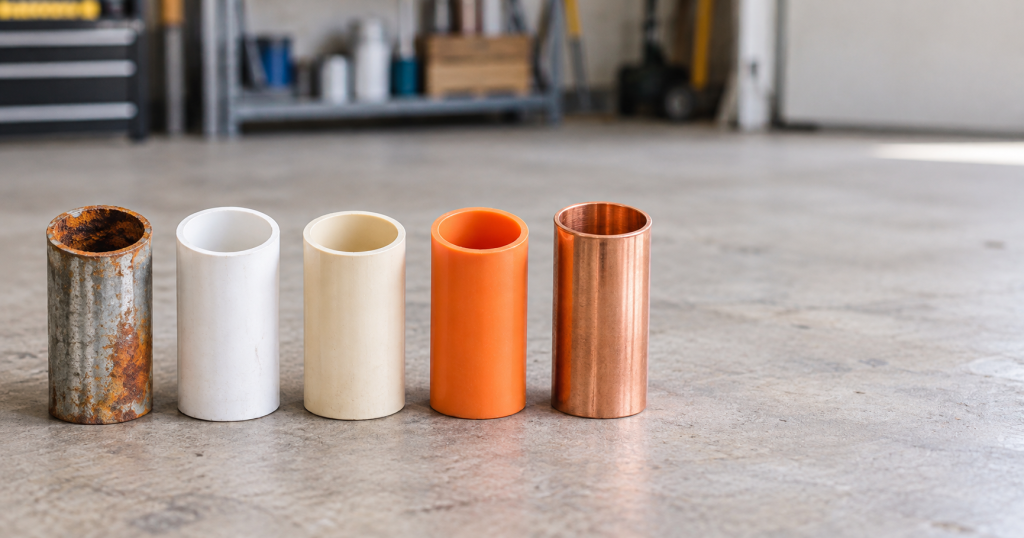
Sometimes both houses receive identical water and the difference is made inside the walls. Old galvanised iron pipe rusts from the inside and adds colour and a metallic taste; our post on iron in water shows what that looks like. A long dead-leg line to a rarely used tap sits stagnant and picks up smell, which is why water often smells only in the morning. A leaking joint can pull in dirt. Two houses built ten years apart have very different pipe.
Reason 5 — the tank and sump
Storage can ruin good water after it arrives. An uncleaned sump, a cracked or open lid, a black plastic tank in direct sun, sediment that has never been drained: each one changes the water on its way to your tap. Our guide on how long stored water stays safe covers cleaning and cover.
Reason 6 — the geyser and hot line
If only your hot water smells or stains, the geyser is the suspect, not the source. Scale builds up inside the tank, the anode rod wears out, and warm still water grows things that cold water does not. This is one of the most common misdiagnoses. People buy purifiers for a problem that lives in the geyser.
Reason 7 — what each house already treats
Your neighbour may have a softener on the inlet, a sediment filter before the tank, or a purifier under the counter that you have never seen. The water reaching their glass is not the water reaching their meter. Always ask what they have installed. A house that “just has good water” often has a filter someone fitted years ago and forgot about.
Same street, different water
| Cause | Sign you would notice | How to check |
|---|---|---|
| Borewell depth and layer | Harder water or more scale than the neighbour’s borewell | Ask the driller how deep each bore went |
| Different source altogether | Your water tastes nothing like theirs on the same day | Ask whether they are on supply, borewell or a blend |
| Tanker deliveries | Water changes from week to week | Ask the supplier where each load is filled |
| Old pipes | Colour or metallic taste that clears after running the tap | Compare the first glass of the day with one after two minutes |
| Sump and tank | Smell or sediment that is absent at the inlet | Test at the inlet, then at the tank outlet |
| Geyser | Only the hot tap smells or stains | Compare cold and hot from the same tap |
| Existing treatment | Neighbour’s water is soft or clear with no obvious reason | Ask what filters or softeners they have fitted |
How to find your cause in one evening
You need a clean glass and a TDS meter. Work through these in order.
- Cold tap versus hot tap. If only the hot water is bad, the geyser is your answer and the source is cleared.
- Kitchen versus bathroom versus the tank outlet. If the tank outlet is clean but one tap is not, the pipe run to that tap is the problem. If the outlet itself is bad, look at the tank and sump.
- Run a tap for two minutes and retest. If the problem clears, the water was sitting in the pipe. Stagnation and old pipe are in; the source is out.
- Fill a glass and take it away from the sink. Check the colour against a white sheet and smell it in another room. A smell that stays with the glass is in the water. One that fades was from the drain.
- Test TDS on both waters with the same meter. Similar readings point to pipes, storage or the geyser. A large gap points to a different source or a different borewell layer. Our post on the right TDS level for drinking water explains how to read the number.
When to get a lab test
A home TDS meter cannot tell you what the dissolved solids are. Get a lab test when there is a big TDS gap with no explanation, when the water has colour or stains fixtures, when a smell never clears, or when anyone in the house keeps falling ill. Test before buying anything. A report costs less than a purifier that solves the wrong problem.
Bottom line
Your neighbour’s setup is not a benchmark for yours. Find where your water is different, whether source, pipe, tank or geyser, and treat that one thing. Our RO vs UV vs UF buying guide helps you match the purifier to what the test shows.
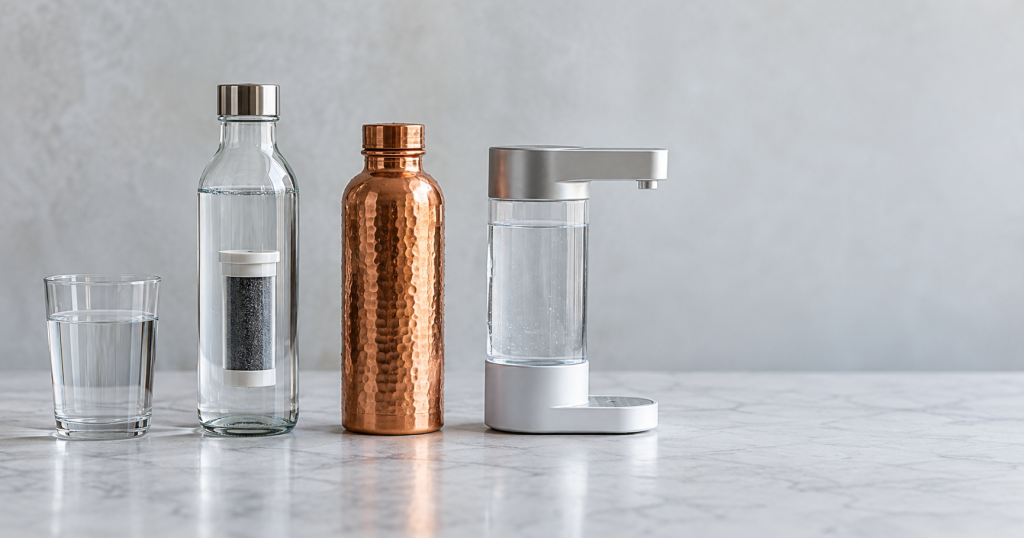
If the answer is the source itself, a purifier that handles changing water helps. The LUXGEN Aura combines RO, UV and UF with a built-in TDS controller that retains essential minerals, and it is made for borewell, municipal and tanker water alike.