Tanker Water: From Where It’s Filled to Your Sump, Step by Step

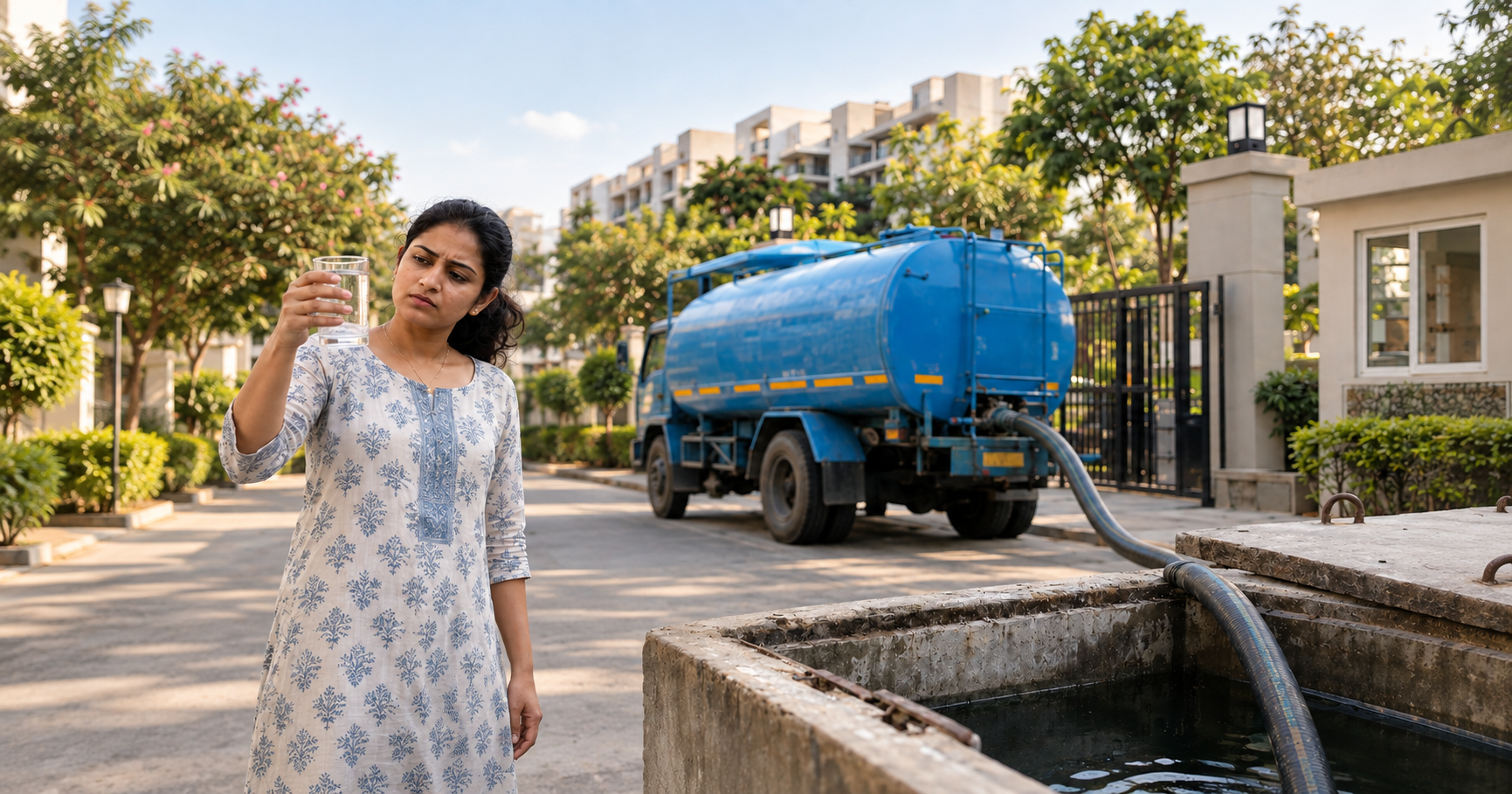
In many Bengaluru and Hosur apartments and houses, the water tanker is not an emergency. It is the weekly supply. Most people have the driver’s number saved on their phone, but very few know where the water actually came from. If you follow one tanker from its source to your sump, step by step, it becomes clear what is worth checking and what is not.
Where tanker water usually comes from
Most tanker water comes from borewells on private land, often at the edge of the city. Some comes from open wells or lakes, and some from a municipal filling point. Each source means different water. Borewell water tends to be hard and high in TDS, with all the usual borewell water problems. Lake or open-well water is often lower in TDS but carries more dirt and germs.
You usually cannot know the source unless you ask. So ask. It is an ordinary question, and most suppliers will simply tell you.
Step 1 — filling
At the filling point there is a pump, a hose and a hose end. The water may be fine in the ground, but it has to pass through that hose. A hose that is dragged along the ground, or left lying in a ditch between trips, carries dirt straight into the tank. The fix is simple: keep the hose end off the ground.
Step 2 — the tank on the truck
Truck tanks are steel or plastic. Both are fine when clean. The trouble is that the inside is rarely seen, so it is rarely cleaned. Over time sediment settles at the bottom, steel tanks rust, and a slimy layer called biofilm grows on the walls. If your delivery sometimes looks reddish-brown, rust is one likely reason — our post on iron in water explains that colour.
Also, the same tanker may carry construction water one day and drinking water the next. That is normal business, but worth knowing.
Step 3 — the trip
On the road, the lid matters. A sealed lid keeps out dust, leaves and insects. An open top in dust and heat does not help. Time matters too. Warm water sitting in a tank for hours gives bacteria a comfortable place to grow. A short trip with a closed lid is better than a long wait in the sun.
Step 4 — delivery into your sump
Now the hose appears again, this time at your gate. The same rule applies: the hose end should be clean and should not have been dragged along the road. Then look at your own side. Is the sump lid intact and tight-fitting? Is the sump mouth at road level, where rainwater, dust and wash water can run straight in? Many tanker water problems start here, not at the source. A cracked lid can undo an otherwise clean delivery.
Step 5 — your sump and overhead tank
Once the water is in your sump, it is your responsibility. Sediment settles and gets stirred up by every new delivery. Algae grows wherever light gets in. If you buy from different tankers, water from different sources stacks up in the same sump.
Stored water does not stay fresh forever — see how long stored water stays safe. And if your taps smell odd first thing in the day, see why water smells in the morning.
Tanker checkpoints
| Checkpoint | What can go wrong | What to check or ask |
|---|---|---|
| Source | Hard, high-TDS borewell water, or dirty lake or open-well water | Ask where the water is from |
| Filling hose | Hose end lying on the ground or in a ditch | Ask how the hose is kept between trips |
| Truck tank | Sediment, rust and biofilm inside | Ask when it was last cleaned |
| Lid during transport | Dust, leaves and insects, and warm water sitting for hours | Look for a closed, sealed lid |
| Delivery hose | Road dirt carried into your sump | Look at the hose end before it goes in |
| Sump | Rainwater and dust entering, and settled sediment | Check the lid, the mouth level and the cleaning schedule |
| Overhead tank | Algae, smell and stale water | Keep it covered, dark and cleaned on schedule |
Five questions to ask your tanker supplier
- Where is the water from?
- Is it the same source every time?
- When was the tank last cleaned?
- Is this tanker used only for drinking water?
- Can I see the hose end before you start?
None of these is rude. A good supplier will not mind. Tanker operators keep a lot of homes running, and the careful ones deserve your repeat business.
Quick checks when the tanker arrives
You do not need a lab. Catch the first water from the hose in a clean glass or white bucket. Check the colour, smell it, and look for floating particles. Then test the TDS with a simple meter and write the number down. A big jump from last week means a different source, whatever you were told. If you are not sure what the reading means, our guide to the best TDS level for drinking water will help.
Making tanker water safe to drink
Never drink straight from the sump or the overhead tank. Drinking water needs one more step.
- Keep the sump clean, covered and closed to rainwater.
- Clean the sump and the overhead tank on a fixed schedule, not just when the water starts to smell.
- Treat your drinking water with a purifier chosen for the TDS you actually get.
Tanker water from borewells usually needs RO, because dissolved salts are the main issue. Low-TDS lake water or municipal refill water may only need UV/UF, because germs are the main issue. Our RO vs UV vs UF buying guide helps you match the purifier to your water, and the post on common water impurities explains what may be in your water in the first place.
If your tanker water changes from week to week, a purifier with an adjustable TDS controller is useful. The LUXGEN Royale Copper combines RO, UV and UF with a TDS controller that can be tuned to your supply.
Bottom line
The tanker is only one step in a long chain, and it is often not the weakest one. Know the source. Watch the hose. Keep your sump clean and covered. And treat the water you drink. Do these four things and the weekly tanker stops being a worry.