

Scale in Your Geyser vs Scale on Your RO Membrane: Two Different Problems

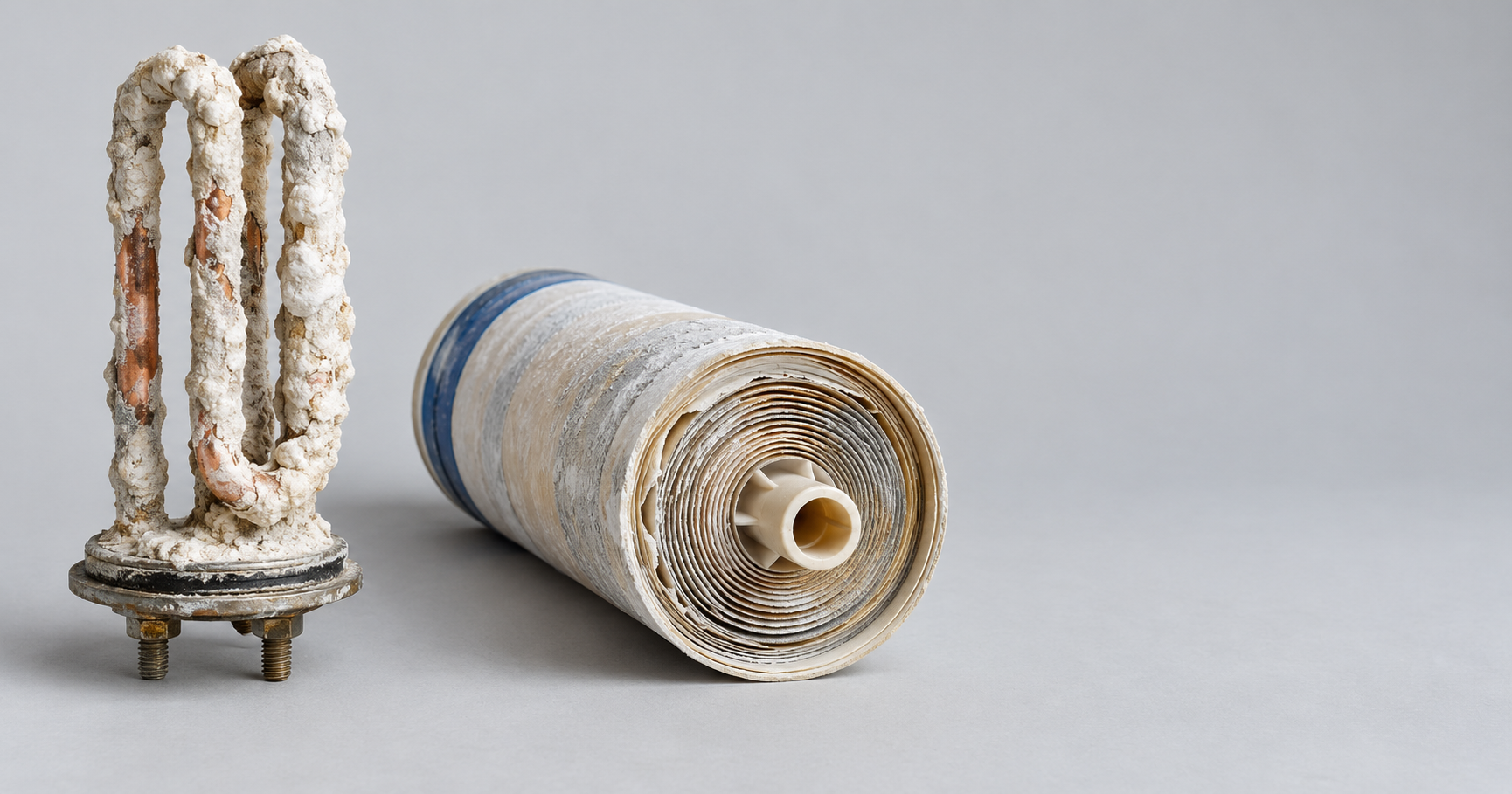
Open up the heating element of an old geyser and you will usually find it coated in a hard white crust. Open the housing of an RO purifier that has been running on the same supply and the membrane is fouled too. Same hard water, same house, same calcium. But the two deposits formed for different reasons, in different ways. That is why softening your bathroom line does nothing for your drinking water, and a new membrane does nothing for your geyser.
What scale actually is
Hard water carries calcium and magnesium in dissolved form. Dissolved means they have broken down into the water itself. You cannot see them, and as long as conditions stay the same, they stay in solution.
Scale is what happens when conditions change and the water can no longer hold all of that calcium and magnesium. The minerals come back out of solution and settle on the nearest surface as a hard, chalky deposit. Our guide to hard water problems and water softeners covers the wider damage around the house. Here we look at two places it forms, each with its own trigger.
The geyser: heat drives it
Hot water can hold less dissolved calcium than cold water. So when a geyser heats the water, some of the calcium that was happily dissolved is pushed out of solution. It has to go somewhere, and it settles on the hottest surface in the tank: the heating element.
The hotter the thermostat setting, the more calcium is forced out and the faster the crust builds. Over time that crust acts like insulation wrapped around the element. Heat has to pass through it before it reaches the water, so heating takes longer and uses more electricity. The element runs hotter inside its coating, and eventually it fails.
A geyser scales from the inside out, on the hot part.
The RO membrane: pressure and concentration drive it
An RO membrane works differently. Pressure pushes water through the membrane, and the dissolved salts are left behind on the feed side. Our explainer on what reverse osmosis actually means walks through that pressure mechanism.
The important consequence is this. As clean water passes through, the water left sitting against the membrane surface becomes more concentrated than the water that came in. Past a point, that concentrated layer cannot keep the calcium dissolved, and it precipitates right on the membrane face.
No heat is involved at all.
Why that matters: they are not the same deposit
Geyser scale is a thick crust on one hot component. The element can carry a visible layer for a long time and keep working, just less efficiently.
Membrane scale is a thin film spread across the whole active surface. It does not need to be thick, because it blocks the tiny pores the clean water has to pass through. A layer you could barely see is enough to choke a membrane. The membrane is far less tolerant of scale than a geyser.
Two kinds of scaling
| Geyser | RO membrane | |
|---|---|---|
| What drives it | Heat | Pressure and concentration |
| Where it forms | On the heating element | Across the membrane surface |
| What you notice first | Slower heating, higher bills | Slower tank fill |
| How fast it fails | Slowly; tolerates a thick crust | Faster; a thin film is enough |
| What the fix is | Softening the incoming line, lower thermostat, flushing | Pre-filters, a suitable membrane, pre-softening only for very hard feed |
| What the fix is NOT | A new purifier membrane | A bathroom-line softener on its own |
How each one announces itself
A scaling geyser gives fairly clear signs:
- Water takes longer to heat than it used to.
- Electricity use creeps up.
- A rumbling or popping sound, as water trapped under the crust boils in small bursts.
- Less hot water than before, because scale and sediment take up space in the tank.
A scaling RO membrane is quieter about it:
- The storage tank fills more slowly.
- The pump runs longer to fill it. Our post on why a water purifier is noisy explains what a busy pump is telling you.
- The TDS of the purified water slowly creeps up.
- Eventually the membrane passes almost nothing at all.
Why the fixes are different
A water softener on the house line protects the geyser, the washing machine, the taps and the tiles. It removes hardness before the water is heated, so there is far less calcium left to come out on the element. The same softened water is what stops the stiff-towel problem described in our guide to hard water and your washing machine.
But softened water is not meant for drinking or cooking. Ion exchange swaps hardness for sodium. Our post on cooking with hard water covers what that means in the kitchen.
For the purifier, protection comes from somewhere else: the pre-filters, a membrane rated for your feed water, and a softener ahead of the RO only where the feed is genuinely very hard. One fix, two different placements.
What actually extends the life of each
For the geyser:
- Lower the thermostat setting rather than running it at maximum.
- Flush the tank periodically to clear loose scale and sediment.
- Soften the incoming line if your water is hard.
For the RO purifier:
- Change the sediment and carbon cartridges on schedule. They exist to protect the membrane.
- Do not ignore a pump that runs longer than it used to.
- Match the membrane to your feed water instead of buying on price.
Know your water before you buy either fix
Hardness and TDS are different numbers, and a proper water test report shows both. Our guides on how to read a water test report and the best TDS level for drinking water explain what each one tells you.
Buying a softener for water that is already soft, or an RO purifier for a germ problem, is money spent on the wrong thing. Our RO vs UV vs UF buying guide helps you match the purifier to the problem.
If your report does show hard water and your geyser is already struggling, a softener on the incoming line, such as the EIA Soft Smart treats the line before it reaches the heater.
Bottom line
Heat makes scale in your geyser. Pressure and concentration make it on your membrane. It is the same calcium, but two different mechanisms put it in two different places, so the fix goes in two different places too.