RO Water for Aquariums and Plants: Why Hard Water Hurts Them

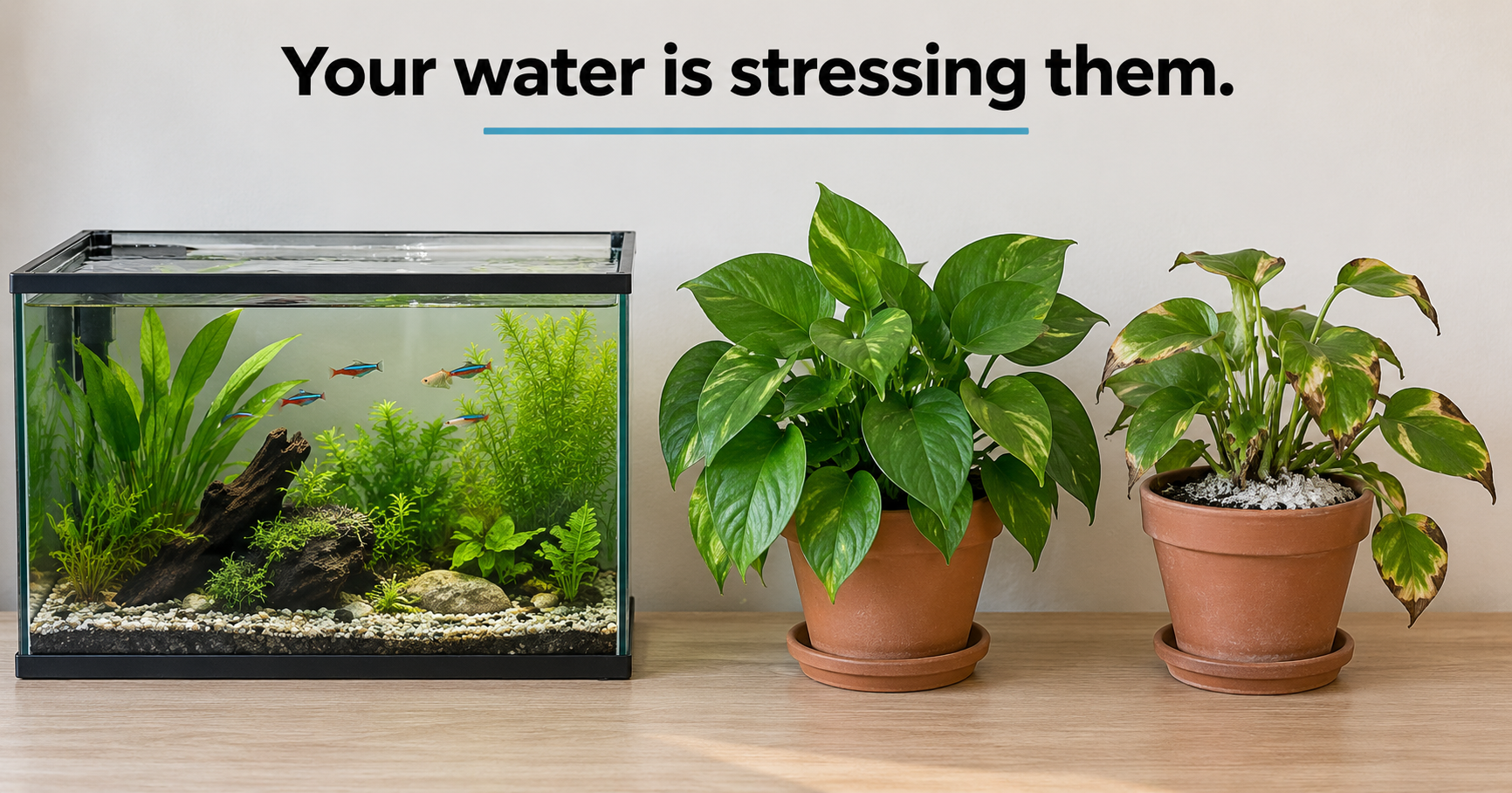
Most homes now filter the water they drink, then fill the fish tank from the tap and water the money plant from the same jug. A person drinks two litres a day and has a liver and kidneys to handle it. A fish lives inside that water all day and breathes it through its gills. A plant cannot walk away from the salt collecting in its pot. Both are far more sensitive to water chemistry than we are, and both show it late — a dull fish that hides, a plant with brown leaf tips — long after the water caused it.
What is actually in your tap water
Municipal water in India is treated to be safe for people to drink, not to be gentle on fish or houseplants. What reaches your tap usually carries:
- TDS (total dissolved solids): everything dissolved in the water, in ppm. City supply is often 150–500 ppm; borewell water can cross 1,000. See the best TDS level for drinking water.
- Hardness — calcium and magnesium: the minerals that scale your taps also crust soil and pot rims.
- Chlorine and chloramine: added deliberately to kill bacteria. Chlorine escapes into the air on its own; chloramine is far more stable.
- Nitrate: from farm runoff and sewage seepage. It feeds algae in a tank.
- Fluoride: naturally high in parts of Tamil Nadu, Andhra Pradesh and Rajasthan, and some plants react at levels people never notice.
- Iron: common in borewell supply, and it stains everything brown.
The full list is in our guide to common impurities in tap water, and high TDS and its health effects.
Why aquariums are so sensitive
A fish tank is a small closed system — whatever you pour in stays there until you change the water.
- Chlorine and chloramine damage gills. Even a small dose irritates gill tissue and the fish starts gasping at the surface. Chloramine at tap-water levels can kill small fish.
- They also kill your filter. The beneficial bacteria in the filter media convert fish waste into less toxic forms. One bucket of raw tap water can wipe out that colony, and the ammonia spike that follows kills more fish than the chlorine.
- Hardness and pH swings stress fish. Fish spend energy holding their internal salt balance steady, and water much harder than they evolved for keeps them under constant strain — poor colour, no breeding, weak immunity.
- Different species want different water. Soft-water fish — tetras, discus, bettas — come from low-mineral rivers. Hard-water fish — guppies, mollies, African cichlids — need minerals and do badly without them.
This is where RO water earns its place. Hard tap water gives you one fixed recipe you must accept. Starting from RO, you set the hardness and TDS yourself, and it stays the same at every water change.
One clear warning: pure RO water alone is not aquarium water. At near-zero TDS it has no minerals and almost no buffering, so the pH can crash without warning. RO water must be remineralised with an aquarium mineral mix, or blended with tap water — commonly 50:50, adjusted to the species. Always test the mixed water for TDS, pH and hardness before any fish goes in.
Why plants react to hard water
Plants take the same water, but the damage builds differently: water leaves through the leaves, and the minerals stay behind in the pot.
- White crust on soil and pot rims: calcium and magnesium left behind as water evaporates.
- Salt build-up in the root zone: as salts concentrate, roots struggle to pull water in and the plant wilts even though the soil is wet.
- Leaf tip burn: chloride and fluoride collect at the edges and tips, which turn brown and dry while the rest of the leaf looks fine.
- Chlorine harms soil microbes: what protects drinking water also works against the microbes in potting mix.
Sensitive plants: money plant, spider plant, peace lily, calathea, orchids, and carnivorous plants such as sundew and pitcher plant, which need low-TDS water and nothing else.
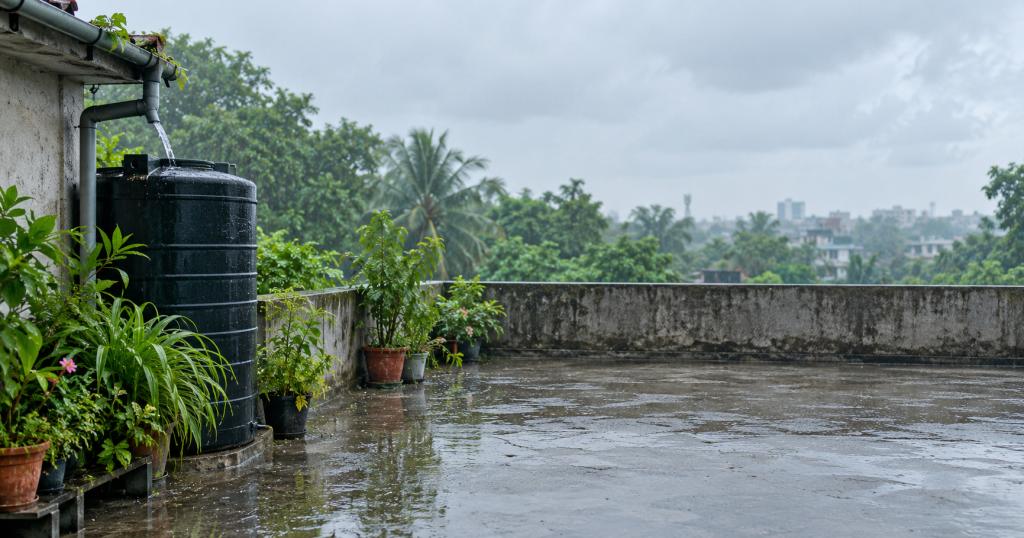
Tolerant plants: succulents, snake plant, and almost everything growing outdoors, where rain flushes the salts away.
Tap, RO or rainwater: a quick comparison
| Water | Fish tank | Houseplants | Leaf tips & soil crust | Cost | Watch out for |
|---|---|---|---|---|---|
| Tap water (hard) | Only after dechlorinating; fine for hard-water species | Fine for tolerant plants | Crust and tip burn over months | Lowest | Chlorine, chloramine, hardness |
| RO water | Excellent base, but must be remineralised or blended | Best for sensitive plants, ideally blended | Almost none | Purifier plus filters | Never use at 0 TDS alone |
| Rainwater | Very good if collected clean | Very good — naturally soft | None | Free, but seasonal | Roof dust, bird droppings, first flush |
Simple rules to follow
- Test the TDS first. A pen-type TDS meter costs a few hundred rupees and settles it in ten seconds. Everything below depends on that number.
- For tanks, match the TDS to the species — and never add 0 TDS water straight from the RO tap. Remineralise or blend it, then test before the fish go in.
- Standing tap water overnight only removes chlorine. Hardness, chloramine, nitrate and fluoride are exactly the same the next morning.
- Blend RO 50:50 for sensitive plants. Pure RO carries no minerals at all, so a blend suits potted plants better over the long run.
- Flush the pots once a month. Water heavily until it runs out of the drainage hole and throw that runoff away — it washes accumulated salts out of the root zone.
- Never water plants with softened water. An ion-exchange softener swaps calcium for sodium, and sodium in the root zone does real damage — take the plant tap from before the softener. See softened water versus RO water and what hard water does to your home.
When you do not need RO
Not every home needs it here. Skip RO if your municipal supply is under about 200 ppm and only needs dechlorinating; if you keep hardy plants or an outdoor garden; or if your tank holds hard-water species like guppies, mollies or African cichlids, which do better in mineral-rich water anyway.
When RO genuinely helps
RO is worth it above roughly 400 ppm TDS, or on borewell or tanker supply, where hardness, iron and nitrate swing month to month. It also helps with soft-water or breeding fish, expensive indoor plants like orchids and calathea, or white crust appearing on pots, taps and tiles across the house.
Bottom line
Know the number before you pour. A ten-second TDS test tells you whether your tap water is a quiet problem for your tank and pots, or perfectly fine. If the number is high, RO gives you a clean base you can adjust — remineralised for the tank, blended for the plants — instead of accepting whatever the tap gives you.
If an RO purifier is the answer, the LUXGEN Royale Copper RO purifier is a good place to start, and our RO vs UV vs UF buying guide explains which type suits your water.