Ice Cubes and Fridge Water: The Contamination Nobody Checks

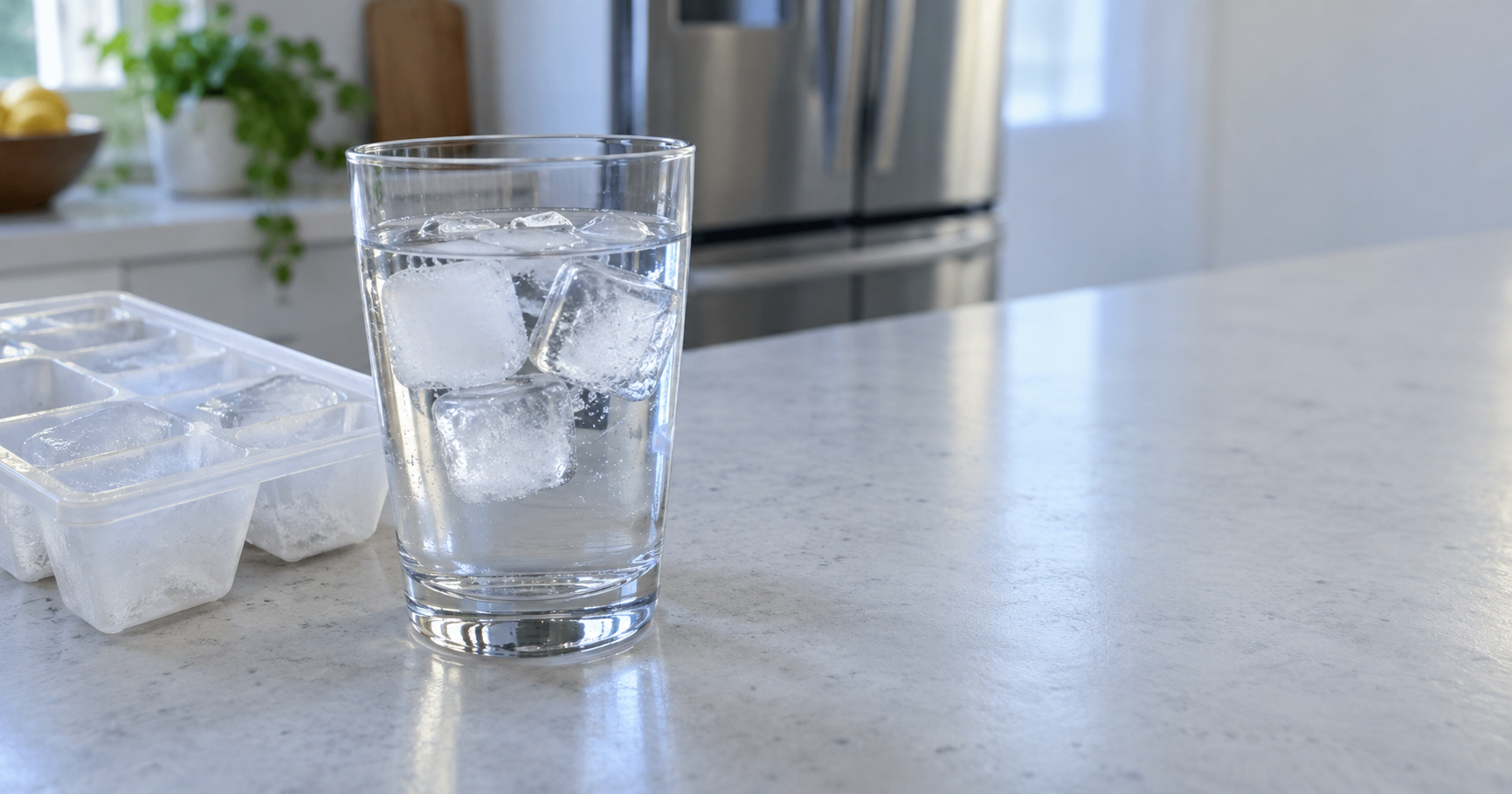
Most of us have become careful about drinking water. There is a purifier on the wall, the filters get changed, someone in the house knows roughly what the TDS is. Then the glasses come out, and in goes ice from a tray that has sat open in the freezer for months, inside a fridge nobody has cleaned in a year.
That is the blind spot in most Indian kitchens. We purify the water, then stop paying attention to what happens next: the ice tray, the bottle refilled and pushed back into the door, the dispenser nobody has opened up. Water is only as clean as the last surface it touched.
The big myth: freezing does not kill germs
This one belief causes most of the trouble. Freezing is not a cleaning step. It is a pause button.
Cold stops bacteria multiplying, which is why a fridge keeps food from spoiling. It does not reliably destroy them. Many common organisms survive being frozen, sit dormant inside the cube, and become active again as the ice melts.
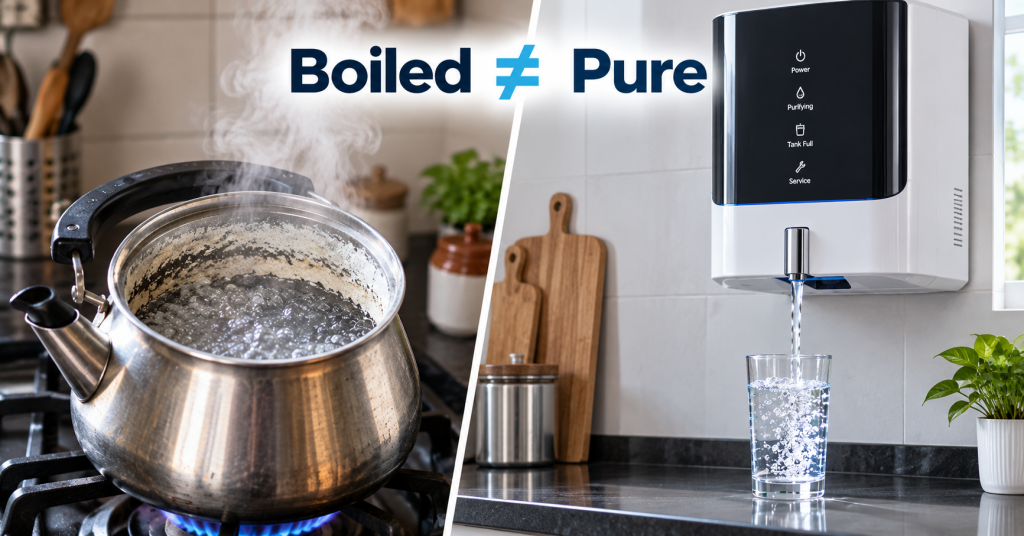
Boiling kills germs. Freezing only pauses them. And freezing shares boiling’s other limitation: it does nothing about anything dissolved in the water. Our guide on what boiling water does not remove explains that gap.
Where ice actually picks up contamination
Ice picks it up at several points:
- The water used to fill the tray. This is the big one. Many households purify what goes into the jug but fill the tray from the tap. That ice carries whatever the tap carries — see our guide to common water impurities.
- Hands. Fingers go into the tray to twist cubes loose, then back in for the next glass.
- An open tray in a shared freezer. Ice absorbs odours and airborne particles from whatever is stored around it, especially uncovered meat, fish and cut onion.
- Old scratched plastic trays. Once scratched, those grooves hold a film of bacteria that rinsing does not lift.
- Time. Ice left for weeks picks up freezer smell.
- Refreezing. Cubes that melted in a power cut and were frozen again spent hours at a temperature where bacteria multiply freely.
Fridge water bottles and dispensers
The water people actually drink daily gets even less attention:
- Bottles refilled but never washed. A bottle topped up for weeks is a container that has not been cleaned in weeks.
- Drinking straight from the mouth of the bottle puts mouth bacteria back into clean water when you refill it, and cold does not remove them.
- Biofilm in the neck and cap. The narrow neck and the threads under the cap are hardest to reach and first to turn slippery.
- Dispenser lines and tanks. Fridges with a dispenser hold water in a tank and tubing most households never clean.
- Hard water leaves scale inside the line. The deposits that build up in a kettle build up in the tubing too — our guide on hard water problems and how a softener fixes them covers why.
Signs your ice or fridge water is a problem
- Ice that smells of the fridge, or tastes faintly of last night’s dinner.
- Cloudy ice, or ice with a flat, stale, slightly off taste.
- White or grey flakes left in the tray.
- A slimy feel inside the bottle neck or under the cap.
- Water that tastes stale even though the purifier is working fine.
The last one is the useful clue. If water tastes good at the purifier tap but poor from the fridge, the problem is downstream of the purifier — in the container, not the filter.
What people believe vs what is true
| Common belief | What is actually true | What to do |
|---|---|---|
| Freezing kills bacteria | Cold only stops them multiplying; many survive and revive as ice melts | Start with water that is already safe to drink |
| Ice is always safe | Ice is exactly as clean as the water, tray and hands that made it | Use purified water and a clean covered tray |
| A fridge is clean because it is cold | Cold slows spoilage but does not clean surfaces; spills and odours stay | Wipe shelves and the dispenser tray regularly |
| Cloudy ice means dirty water | Cloudiness is usually trapped air and dissolved minerals, not contamination | Check TDS and hardness rather than assuming dirt |
| A bottle only holds water, so it needs no washing | Biofilm forms in any container refilled and never washed | Wash the bottle, neck and cap every two to three days |
Why cloudy ice is usually not dirt
Cloudy ice worries people far more than it should. In most cases it is not contamination at all.
Ice freezes from the outside in. Air and minerals dissolved in the water get pushed ahead of the freezing edge and end up trapped in the middle, which is why the centre looks white while the edges stay clear. That is physics, not dirt.
It does tell you something about your water: the more dissolved solids it carries, the cloudier the ice and the more white powder left in the tray as it melts. So cloudy ice is a hardness and TDS signal, not a hygiene signal — our guide to the best TDS level for drinking water explains what that number should be.
Simple fixes that work
- Fill the tray from the purifier, not the tap. This single change fixes most of the problem.
- Keep the tray covered, or use a lidded ice box, so it is not absorbing food odours.
- Wash trays weekly in warm soapy water and dry them fully before refilling.
- Replace scratched plastic trays. Once the surface is rough, cleaning stops being reliable.
- Do not store ice more than a week. Make smaller batches more often.
- Wash fridge bottles every two to three days, including the neck and cap threads, not just a rinse of the body.
- Clean the dispenser drip tray and follow the manual for cleaning the internal tank and line.
- Keep raw food sealed so odours never reach the ice at all.
The same thinking applies to water sitting in jugs around the house — our guide on how long stored water stays safe covers what is reasonable and what shortens it.
What about ice from outside
Ice in juice shops, roadside stalls and many restaurants is bought in, made from source water nobody at the counter can tell you about, and handled by hand or with a scoop that lives in the bucket. It is also the one part of a meal that is never cooked.
That is not a reason to panic over every cold drink, but it is a reason to be selective — particularly for young children, for travellers whose stomachs are not used to the local water, and for anyone already unwell.
Bottom line
Filtering your water only helps if everything downstream is clean too. The purifier does its job at the tap; the tray, the bottle and the dispenser decide what reaches the glass.
Three things cover almost all of it: know your TDS, make ice from purified water, and wash the containers.
If your supply is hard or high in TDS — cloudy ice and white residue are a fair hint — the LUXGEN Royale Copper RO purifier deals with that dissolved load before the water ever reaches the freezer. If you are still deciding what suits your water, our RO vs UV vs UF buying guide walks through the choice.