Bottled Water vs Home RO: Cost and Safety Over One Year

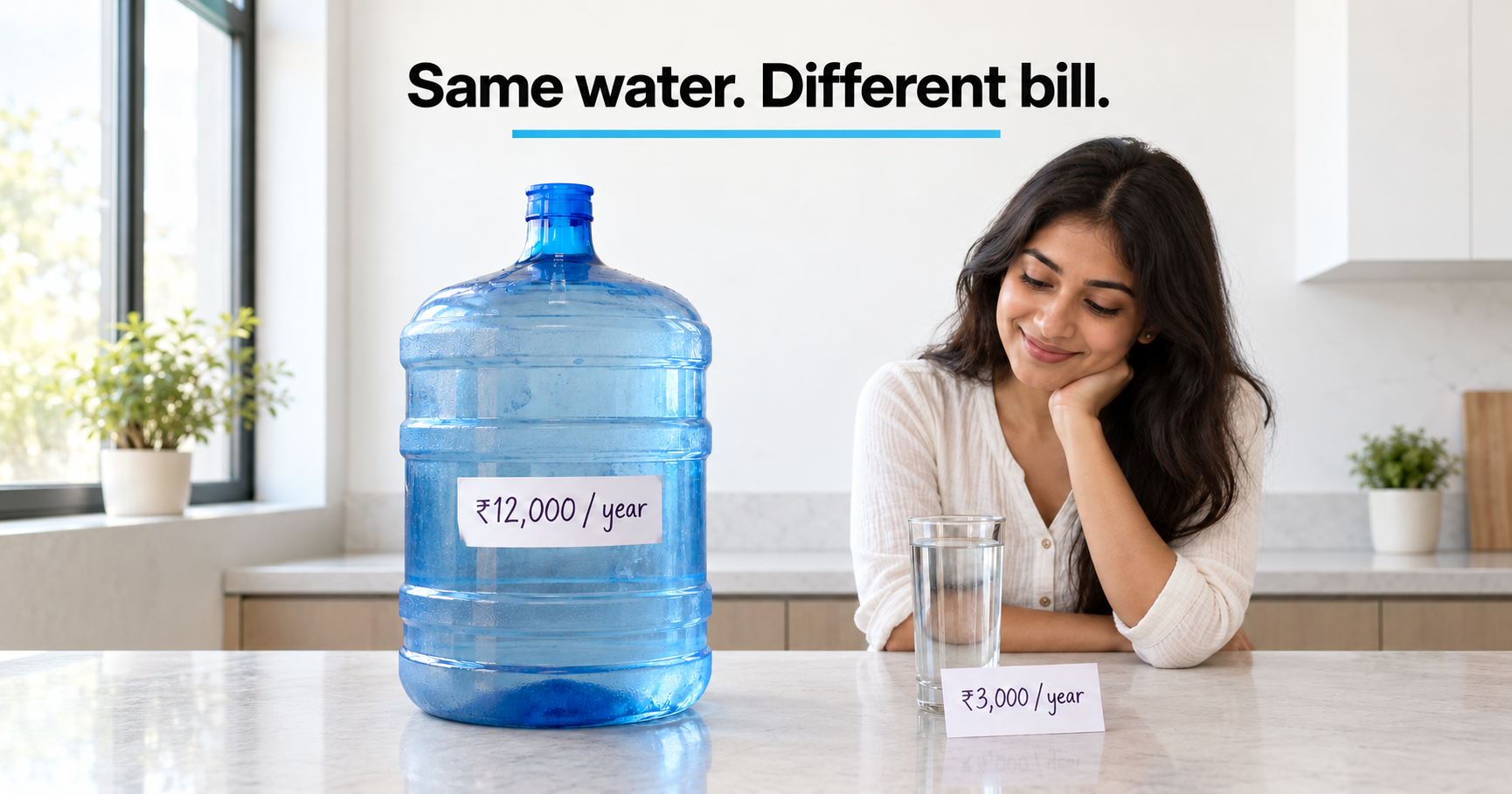
In most Indian cities the 20-litre can is the default answer to drinking water. One phone call, and a can arrives at your door. In Bengaluru and Hosur it costs roughly ₹40–80, depending on the brand and the distance from the plant. Per can it feels cheap. The problem is that almost nobody adds it up. This guide puts twelve months of cans side by side with a home RO purifier, including the parts that never appear on the bill.
How much water a family actually uses
Before comparing money, fix the quantity. Most people underestimate it.
- Drinking: 2 to 2.5 litres per adult per day, more in summer — 7–9 litres for four people.
- Cooking: rice, dal, sambar, tea and coffee take another 2–3 litres a day.
- Total: roughly 10–12 litres a day for a family of four.
That is 300–360 litres a month, or 15 to 18 cans of 20 litres. Summer and guests push it higher. Everything below scales with this number, so work out your own first.
One-year cost: 20-litre cans
Take 16 cans a month at the usual city rates. At ₹45 a can that is about ₹720 a month; at ₹80, about ₹1,360. Most families sit between ₹700 and ₹1,400 a month — ₹8,000 to ₹17,000 a year. That is only the visible cost. Then come the parts nobody counts:
- Can deposit: ₹150–400 per can is blocked, returned only if you stop the service and the can is undamaged.
- Delivery gaps: Sundays, festival days, the supplier’s day off. You then buy 1-litre bottles at MRP, roughly ten times the price per litre.
- Carrying: a full can weighs over 20 kg. No lift, or delivery that stops at the gate, means somebody lifts it every three or four days, for years.
These are typical ranges from common city rates in 2026, not a quotation.
One-year cost: a home RO purifier
A domestic RO has one big number at the start and small numbers after that.
- The purifier: ₹8,000–15,000 one time, depending on stages, tank size and whether it adds UV, UF, copper or alkaline.
- Filters and service: ₹2,000–3,500 a year. Sediment and carbon filters change once or twice a year; the membrane lasts two to three years.
- Electricity: about ₹25–40 a month. A domestic RO draws 30–60 watts and runs only while filling the tank, not all day.
- Rejected water: an RO sends some water to the drain — a few rupees a month on a municipal connection, and the reject line can go into a bucket for mopping. See how much water an RO wastes and how to fix it.
Year one comes to roughly ₹10,500–19,000 — the same band as a year of cans. Year two onwards is only filters and electricity: about ₹2,500–4,000 a year. Against ₹8,000–17,000 for cans, that is 60–80% cheaper, every year after the first. Again, typical ranges, not quotes for a specific model.
Cans vs home RO: side by side
| Factor | 20-litre cans | Home RO |
|---|---|---|
| Year-1 cost | ₹8,000–17,000 | ₹10,500–19,000 (purifier + filters + power) |
| Year-2 onward cost | ₹8,000–17,000 every year | ₹2,500–4,000 a year |
| Safety / TDS control | Unknown; varies can to can | You choose the purifier and can measure the output |
| Storage hygiene | Refilled cans, cleaning not visible to you | Sealed tank in your kitchen, you clean it |
| Convenience | Order, wait, receive, lift, mount | Open the tap |
| Plastic waste | Cans reused many times, plus bottles on gap days | Almost none after installation |
| Running out of water | Common on holidays and during supply issues | Only during a long power cut |
| Water quality consistency | Changes with the batch and the source | Same every day until filters are due |
The safety question nobody asks
Cost is the easy part. The harder question is what is inside the can, and most buyers have no way to check.
- Cans are refilled, not new. The same can returns to the plant, is rinsed and refilled. How well it was cleaned is not something you can see.
- Seals are often missing. A proper can has a tamper-evident seal. Many delivered cans have a plain snap cap anyone could open.
- Storage in the sun. Cans stacked outside a shop or on an open tempo for hours let bacteria grow in the film left inside.
- The BIS mark is often absent. Packaged drinking water in India is covered by IS 14543 and needs a BIS licence. Many local refill brands print an official-looking label with no real ISI mark. If it is not there, you are trusting the shop, not a standard.
- TDS varies can to can. Test two cans from the same supplier and the readings often differ, because the source or the plant’s settings changed.
Water also does not stay safe indefinitely once stored — see how long stored water is safe to drink. With a home RO it is simpler: water is filtered minutes before you drink it, no jar is re-used, and a ₹300 TDS meter tells you what you are getting.
When cans still make sense
- A temporary stay: a few months on a project, or a rental where you cannot fix anything to the wall.
- Hostel or PG accommodation: no tap point of your own, and usually no permission to install.
- Very low usage: one or two people drinking 3–4 litres a day. A can lasts a week, so the yearly bill stays small.
- No space or no water point: some kitchens have nowhere to mount a purifier.
When a home RO wins
- A family of three or more. Break-even arrives inside the first year, and the saving compounds.
- Your own home, or a long-term rented one. A purifier can be uninstalled and moved, so it is not lost money.
- Borewell or tanker supply. High TDS, hardness, sometimes fluoride or nitrate. Cans cover drinking water but do nothing for cooking water. See borewell water problems in India.
- You are tired of the routine. Ordering, waiting, lifting 20 kg, running out on a Sunday. For many families this is the real reason they switch.
Bottom line
A 20-litre can is convenience you rent. You pay for it again every month, and you never really find out what is in it. A home RO is a one-time buy that pays itself back in about a year and then costs a fraction of what cans cost — a gap of ₹6,000–13,000 a year for a family of four.
Before deciding, do one thing: test your tap water’s TDS. A meter costs about ₹300 and takes ten seconds, and the reading tells you whether you need RO at all or whether UV or UF is enough. Start with our guide to the best TDS level for drinking water, then the RO vs UV vs UF buying guide. If your reading points to RO, the LUXGEN Royale Copper RO purifier is a good place to start.