Terrace Rainwater vs Borewell Water: Which Is Actually Cleaner?

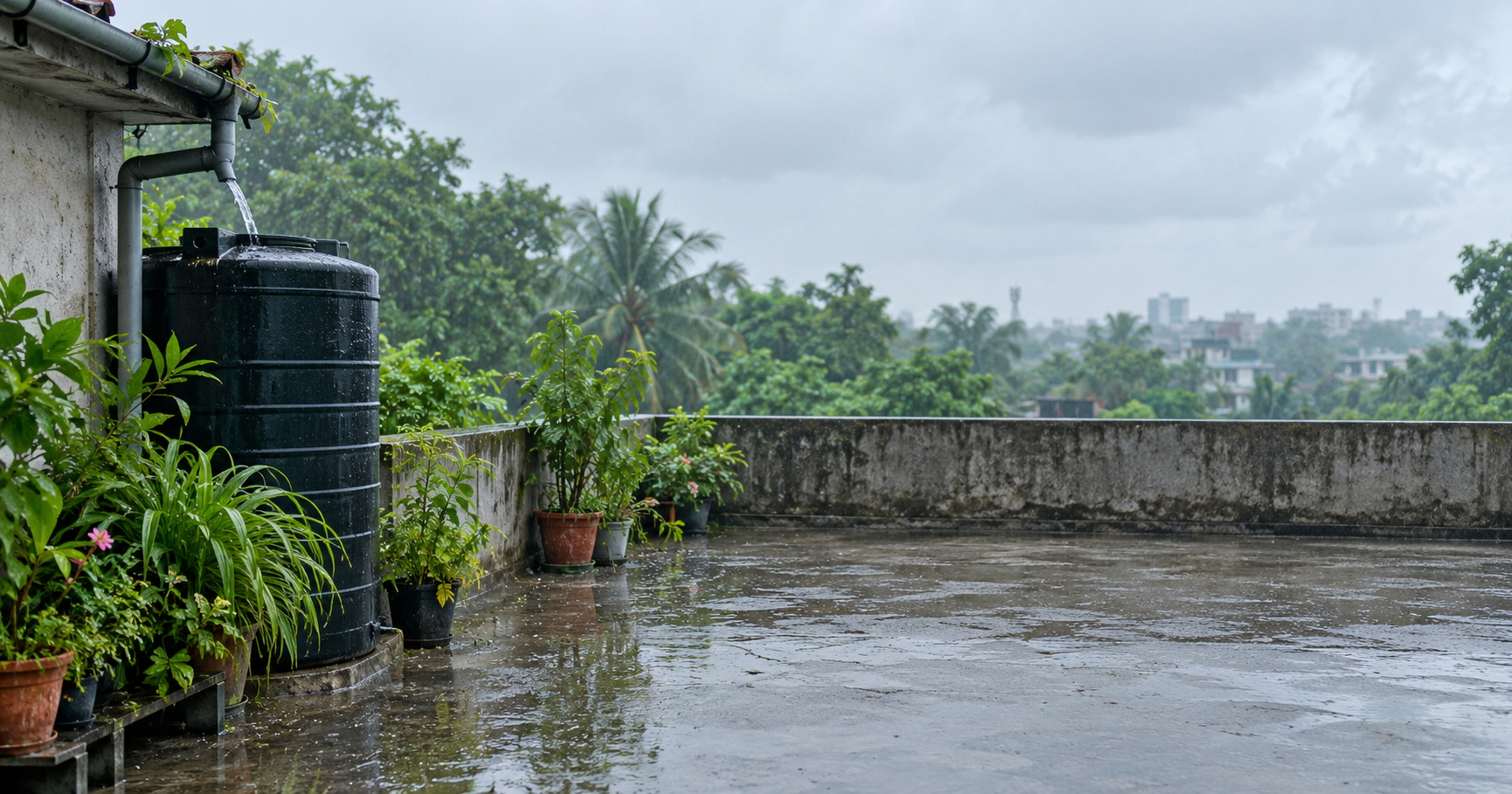
After a good monsoon spell, the question comes up in every Bengaluru and Hosur home. The rainwater tank is full, the borewell water tastes salty, and somebody asks the obvious thing: is the rain water better to drink?
The honest answer is that rainwater is cleaner in one way and dirtier in another. It carries almost nothing dissolved in it — exactly the problem borewell water has. But it lands on a roof first, and that roof decides most of what ends up in your tank.
What rain actually is
Rain is distilled water made in the sky. Water evaporates, leaves every dissolved salt behind, and falls back down. That is why rainwater is naturally very low in TDS and soft.
It does not stay pure on the way down. Rain picks up dust and dissolves gases from the air, which is why fresh rain is slightly acidic. Near cities and industrial belts it can also carry whatever the air is carrying. The first shower after a long dry spell is the dirtiest.
What the roof and the pipes add
This is the real issue, and it has nothing to do with the rain. Between sky and tank, the water runs across a terrace and a gutter, collecting:
- Bird and rat droppings — the main bacterial risk in any harvesting system.
- Dust, leaves, moss and algae built up through the dry months.
- Paint flakes and cement dust from the terrace and parapet.
- Insects, and sometimes a dead lizard or frog in the gutter.
- Whatever else lives on the terrace — plant pots, shoes, old paint tins.
Old tanks add their own algae and sediment. The fair way to put it: rain is clean, but roof-collected rainwater is not automatically clean. The roof is the dirty part.
What borewell water brings instead
Borewell water has the opposite profile. It has filtered through metres of soil and rock, so it rarely carries droppings or leaves. What it carries is everything it dissolved on the way.
That usually means hardness and high TDS, and depending on your area and the depth of the bore it can also mean fluoride, nitrate, iron or salinity. These are the common borewell water problems across South India, and they are invisible — you taste salt and hardness, but not fluoride or nitrate.
There is also a pattern many families have noticed: as borewells went deeper, the water got harder, not cleaner.
Rainwater vs borewell water
| Terrace rainwater | Borewell water | |
|---|---|---|
| TDS and hardness | Very low, naturally soft | Usually high, often hard |
| Bacteria risk | High — droppings, dust, open tanks | Low, unless the bore or sump is contaminated |
| Heavy metals and fluoride | Generally not a concern | Possible, depends on the area and depth |
| Taste | Flat, very soft, almost no mineral taste | Often salty, metallic or heavy |
| Reliability through the year | Seasonal, depends on rainfall and tank size | Available most of the year |
| What it still needs | Disinfection more than filtration | Filtration more than disinfection |
So which one is better to drink?
Neither is drinkable as it arrives. They fail in opposite directions.
Low-TDS water with germs in it is not safe. Germ-free water with high fluoride is not safe either. One problem shows up in a day, the other takes years — which is why people underrate the second.
It also explains a common mistake. Boiling rainwater does deal with the bacteria, but as the boiling vs RO comparison shows, it does nothing about dissolved salts, fluoride or nitrate. For borewell water, boiling is the wrong tool.
First flush: the one habit that changes everything
If you harvest rainwater and do only one thing, do this. A first-flush diverter sends the first few minutes of runoff from each rain out to waste instead of into the tank. That first flow carries the dust and droppings from the roof, so discarding it removes most of the contamination.
The rest is housekeeping: mesh filters at the inlet, gutter guards and leaf screens, and a terrace swept clean before the season. Clean the tank before the monsoon, and again after any long dry gap.
What rainwater is genuinely excellent for, even untreated
Here rainwater wins without argument. For washing, mopping, gardening, flushing, the washing machine and the car, untreated rainwater beats borewell water — because it is soft.
Soft water means less soap, no scale in taps and machines, and no white marks on floors, tiles and car paint. If your supply is hard water, you know what that scale costs. Plumbing rainwater to your non-drinking taps makes harvesting worth it even if you never drink a drop.
Recharge, not just storage
For most Indian homes the bigger win is not the tank at all. It is directing roof runoff into a recharge pit, or a recharge structure around the borewell, so the water goes back into the ground instead of down the drain.
Over seasons this helps lift the water table and dilute the dissolved load in the groundwater below you. Be realistic, though: it works gradually, not as an instant TDS fix, and works best when a whole street does it rather than one house.
If you do want to drink rainwater
It can be done, with care. Use first flush, store it covered and dark, never in an open sump. Do not let it sit for weeks either — stored water has its own shelf life in a tank.
Then treat it for what it is. Rainwater is a disinfection problem, so UV or UF is usually the right fit — full RO would only strip an already low mineral content. For borewell water, RO is exactly the point. The RO vs UV vs UF buying guide covers how to match technology to water.
And test it. Do not guess from taste — taste tells you about salt, not about the rest.
Bottom line
Rain is the cleaner starting point, the roof is the dirty part, and the borewell is the opposite problem: no germs from the surface, but a heavy dissolved load you cannot see or boil away.
So do not pick a winner. Test both, use rainwater freely for everything that is not drinking, and treat each source for what it needs.
If your drinking water is borewell-fed and you are looking at a purifier, the LUXGEN Royale Copper is a practical RO+UV+UF option for that kind of water. Happy to help you read a water test before you decide.