

Type 1 Water: The Purest Water in the World Is Not Drinking Water

Your purifier probably has a TDS display, and you have been taught that a lower number is better. Laboratories take that idea much further than any home purifier can, and the water they end up with is water nobody should drink. Type 1 water, the top grade of lab water, is about as pure as water can physically get. Looking at it closely is one of the best ways to understand what purity actually means.
How labs grade water
Labs do not grade water by TDS. They grade it by electrical resistivity, which is how strongly the water resists carrying a current. Pure water is a poor conductor. What carries current is dissolved ions, the charged bits that salts and minerals break into. Fewer ions means higher resistivity, so a high reading means very clean water. Organic carbon is measured separately, for a reason we come to below. If you want to know what TDS means for drinking water, our guide to the best TDS level for drinking water covers it.
The ceiling
Absolutely pure water has a theoretical resistivity of about 18.2 megohm-centimetre at 25 degrees Celsius. That is a physical ceiling, not a specification. Water molecules split into a tiny number of ions on their own, so even perfect water conducts a little. A lab system reading that figure is at the edge of what physics allows.
ASTM Type I
The best-known grading comes from ASTM D1193-06, the Standard Specification for Reagent Water. Its Type I water must have a resistivity of at least 18.0 megohm-centimetre at 25 degrees Celsius and no more than 50 micrograms per litre of total organic carbon. That is very close to the ceiling. Type I is the water used for the most sensitive analysis and for life-science work, where a trace of anything can spoil a result.
ASTM Type II and below
Under the same standard, Type II water needs a resistivity of at least 1.0 megohm-centimetre, with the same limit of 50 micrograms per litre of total organic carbon. It is general analytical water, and it is also the feed water that a Type I polishing system starts from. Type III and Type IV are progressively less pure grades, used for jobs like rinsing glassware and general washing.
The international standard is different
ISO 3696:1987 grades lab water from 1 to 3 by conductivity, which is simply the opposite of resistivity. Grade 1 allows no more than 0.1 microsiemens per centimetre at 25 degrees Celsius and also limits silica to below 0.01 milligrams per litre. Grade 2 allows no more than 1.0 and Grade 3 no more than 5.0 microsiemens per centimetre.
Here is the important part. ISO Grade 1 is not the same as ASTM Type I. Grade 1’s ceiling of 0.1 microsiemens per centimetre works out to roughly 10 megohm-centimetre, which is measurably less strict than Type I’s 18.0. So when a brochure says “ultrapure”, it could mean either.
Lab water grades
| Grade | Standard | Stated limit | Generally used for |
|---|---|---|---|
| ASTM Type I | ASTM D1193-06 | At least 18.0 megohm-cm at 25°C; organic carbon no more than 50 µg/L | Most sensitive analysis, life-science work |
| ASTM Type II | ASTM D1193-06 | At least 1.0 megohm-cm; organic carbon no more than 50 µg/L | General analysis, feed to Type I systems |
| ISO Grade 1 | ISO 3696:1987 | No more than 0.1 µS/cm at 25°C; silica below 0.01 mg/L | Demanding analysis |
| ISO Grade 2 | ISO 3696:1987 | No more than 1.0 µS/cm | General analysis |
| ISO Grade 3 | ISO 3696:1987 | No more than 5.0 µS/cm | Routine lab work, rinsing |
Clinical laboratories follow a third standard, from CLSI, called clinical laboratory reagent water.
Why resistivity alone is not enough
Resistivity only sees ions. Dissolve something that does not form ions, like sugar, in otherwise pure water, and the meter still reads near the ceiling, even though the water is clearly not clean. A perfect reading can sit on top of water that is plainly contaminated. That is exactly why the standards measure organic carbon separately.
Your home TDS meter has the same blind spot. It reads dissolved ions and nothing else, so it cannot see germs or many other problems. That is why a proper test report has many lines, not one. Our guide on how to read a water test report walks through them.
How fragile it is
Ultrapure water does not stay ultrapure. Left standing in room air, it absorbs carbon dioxide, which forms ions, and the resistivity reading falls away from the ceiling within minutes. Containers and tubing add traces of their own. That is why labs make it at the point of use and use it straight away rather than storing it.
And why you should not drink it
Water with nothing dissolved in it is aggressive: it pulls material out of whatever it touches. It tastes flat and unpleasant. And as drinking water it is pointless, because the minerals you want have been stripped out along with everything else. This is the clearest possible proof that lower TDS is not automatically better. We cover more of that thinking in RO myths that are wrong, and the right range is in our best TDS level guide.
What this means for your home purifier
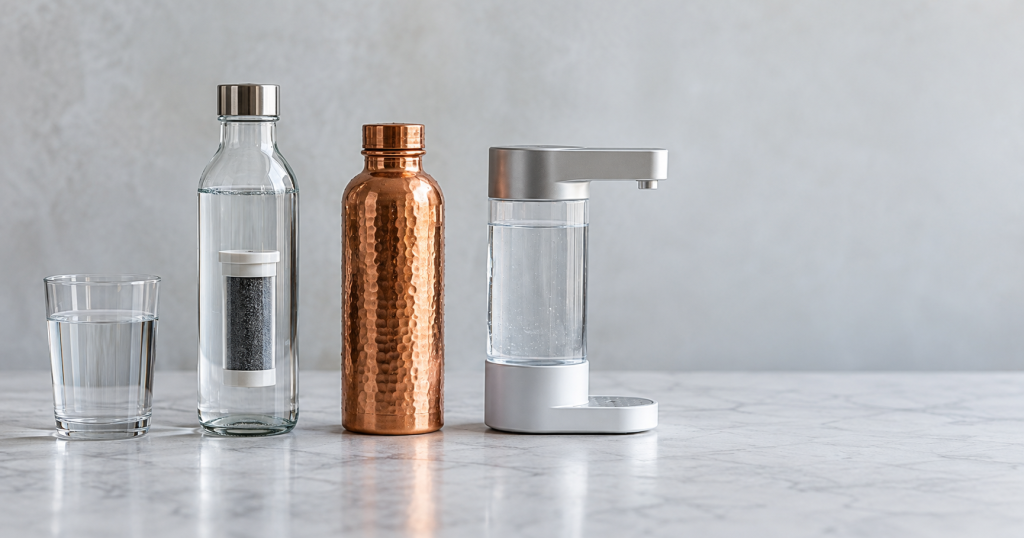
A home RO is not trying to reach lab purity, and it should not. The goal is a sensible mineral level that you enjoy drinking. That is why TDS controllers and mineral cartridges exist: to put back some of what the membrane takes out. For the membrane side, see what reverse osmosis actually means, and for which device solves which problem, water filter vs water purifier.
The practical rule is simple: test your water and treat what the report shows. Our guide to testing water at home versus in a lab explains where to start, and the RO vs UV vs UF buying guide helps you match the machine to the result.
Bottom line
The purest water in the world is made in a lab, used within minutes, and is not fit to drink. Purity is a target you set, not a race to zero. If your water does need RO, the LUXGEN Aura we stock pairs RO with TDS control and mineral retention, so the water stays pleasant to drink.